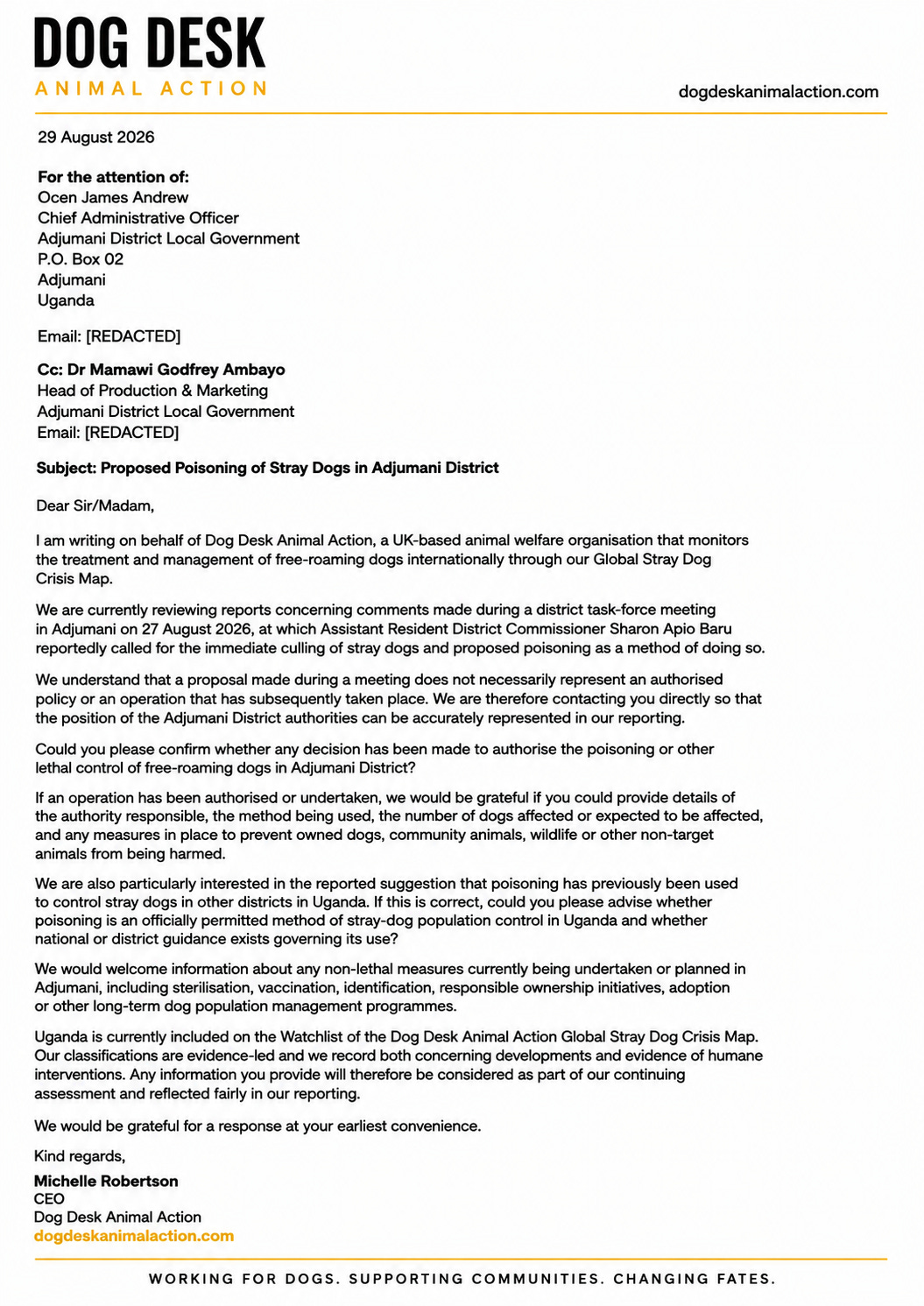
Uganda is already on the Dog Desk Animal Action Global Stray Dog Crisis Map Watchlist, and a development in Adjumani District has given us another reason to keep it there. During a district task force meeting on 27 August, Assistant Resident District Commissioner Sharon Apio Baru reportedly called for the immediate culling of stray dogs and proposed poisoning as the method.
There is another part of the reported comments that particularly concerns us. The official reportedly suggested that poisoning had been used in other districts. We want to know where those operations took place, which authorities authorised them, how many dogs were killed and what substances were used. We also want to establish whether poisoning free roaming dogs is permitted or recognised as a method of dog population control in Uganda.
Those are important questions because not only is it a vile, cruel method of culling that causes the dog extreme & prolonged suffering, the poison does not know which animal an authority intends to kill. An owned dog can encounter poisoned bait. So can community dogs, wildlife and other animals. Poisoned carcasses can create another route of exposure.
There is also a much bigger question about what killing achieves - nothing!
Free roaming dog populations do not appear simply because dogs have not been killed quickly enough. They are shaped by reproduction, abandonment, roaming owned dogs, access to food and waste, responsible ownership and the availability of sustained population management programmes. Remove dogs without addressing those conditions and the conditions remain. Other dogs can reproduce, move into vacated territories or be abandoned into the same environment.
Killing can make dogs disappear from a particular street. That is not the same thing as solving the problem.
Effective population management requires authorities to understand the dog population they are dealing with and intervene before killing becomes the default response. Sterilisation needs to operate at meaningful scale. Owned dogs need to be identifiable. Abandonment and uncontrolled breeding need to be addressed. Communities need access to veterinary services and local authorities need strategies capable of being sustained for years rather than days.
None of that offers the immediate visibility of a cull. It does something much more important. It changes the conditions that create the population in the first place.
Uganda was already on our Watchlist before the comments from Adjumani. We are not changing its classification because one official has proposed poisoning dogs, but we are recording this development as part of the evidence we use to assess the direction in which the country is moving.
If Adjumani authorises a poisoning operation, we will record it. If we establish that other Ugandan districts have already used poisoning as a method of controlling free roaming dogs, we will examine those operations too. We will look for municipal and district instructions, official announcements, procurement records and evidence showing what happened to the dogs.
We will also look for the alternative story, because Uganda does not have to move towards lethal control. If authorities are expanding sterilisation, developing humane population management programmes or replacing killing with sustainable interventions, that evidence belongs on our map record as well.
The Global Stray Dog Crisis Map is not intended simply to identify countries where something terrible has already happened. The Watchlist exists partly so that we can identify warning signs while there is still an opportunity for a different direction to be taken. Adjumani is one of those warning signs.
For now, Uganda remains on the Watchlist. But when poisoning stray dogs is being proposed by a government official, we need to know whether we are hearing an isolated suggestion or seeing the beginnings of something much bigger.