
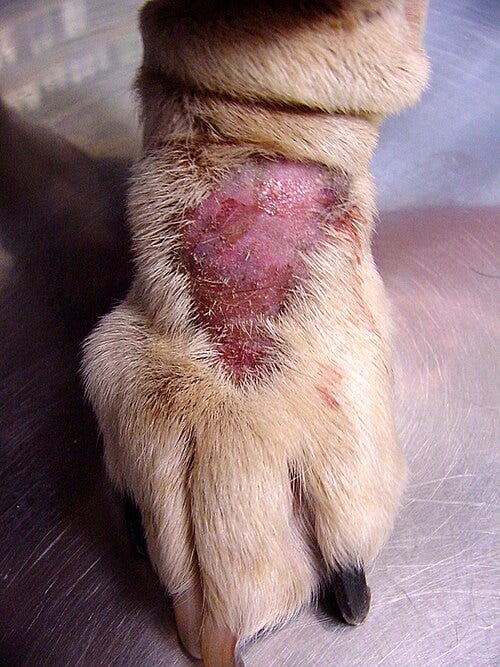
Lick granuloma is often dismissed as a minor behavioural issue. In reality, it is a visible symptom of something unresolved, physical, psychological, or environmental.
Dogs do not repeatedly injure themselves without cause.
When we see a lick granuloma, we are not looking at the problem itself. We are looking at the outcome.
What Is a Lick Granuloma?
A lick granuloma also known as acral lick dermatitis is a chronic skin lesion caused by repeated licking of a specific area, most commonly:
Front legs (especially the wrist area)
Lower limbs
Occasionally paws or flanks
Over time, the skin becomes:
Hairless
Thickened
Inflamed
Ulcerated
What begins as a small irritation can develop into an open, infected wound that is difficult to heal.
This Is Not Just A Habit
It is easy to label excessive licking as boredom or a bad habit.
That framing is not only inaccurate, it delays proper intervention.
Lick granulomas are typically driven by one or more of the following:
Underlying Pain or Medical Issues
Joint pain or arthritis
Nerve irritation
Allergies (environmental or food-related)
Skin infections or parasites
Dogs will often focus on a site of discomfort long before we recognise the source.
Psychological Stress and Coping Behaviour
Licking can become a self-soothing mechanism. This is particularly relevant in dogs who have experienced:
Confinement in shelters
Sudden environmental change (e.g. transport, rehoming)
Chronic stress or uncertainty
Lack of control over their environment
The repetitive action releases endorphins, reinforcing the behaviour over time.
Environmental Mismatch
Some dogs are placed into environments that do not meet their needs. This is not always obvious. A home can be safe, loving, and still unsuitable.
Examples include:
High-energy dogs in low-stimulation homes
Street-born dogs struggling with restriction or routine
Dogs expected to adapt too quickly after transport
In these cases, the body often shows what the dog cannot communicate.
Why Lick Granulomas Are Difficult to Treat
Treatment is not as simple as stopping the licking. Even if the surface wound improves, the underlying cause often remains.
Common challenges include:
Cycle reinforcement: licking reduces stress → dog repeats behaviour
Secondary infection: bacteria complicate healing
Habit persistence: behaviour continues after original trigger resolves
This is why quick fixes—cones, bandages, sprays—rarely work in isolation.
What Effective Treatment Actually Looks Like
Successful management requires a multi-layered approach:
Veterinary Assessment
Rule out pain, allergies, or infection
Use antibiotics or anti-inflammatories where needed
In some cases, investigate neurological causes
Behavioural Intervention
Identify stress triggers
Introduce structured, predictable routines
Provide appropriate mental stimulation
Environmental Adjustment
Reassess whether the dog’s needs are being met
Slow down transitions for newly adopted dogs
Reduce pressure to fit in quickly
Physical Protection (Short-Term)
Cones or protective coverings can help break the cycle
These should support treatment not replace it
A Wider Issue in Rescue and Rehoming
Lick granulomas are increasingly seen in dogs who have been moved rapidly between environments.
From street → shelter → transport → foster → home, often within a short timeframe.
Each transition carries stress. Stacked together, that stress does not disappear—it accumulates.
Not all dogs show it immediately. Some express it weeks or months later, once the initial adrenaline has subsided. This is where careful observation matters.
A dog who is coping is not always a dog who is comfortable.
What We Should Take From This
A lick granuloma is not a minor skin issue. It is communication.
It tells us:
Something hurts
Something does not feel right
Something has not yet been resolved
If we focus only on the wound, we miss the message. Dogs do not have many ways to explain discomfort.
When they lick to the point of injury, they are not being difficult. They are trying to regulate something we have not yet understood. The responsibility is ours to look deeper.
Because when a dog licks themselves raw, the question is not How do we stop this behaviour?
It is:
What is this dog trying to tell us and are we prepared to listen?
Disclaimer:
This article is intended to support understanding, not replace veterinary care. If a dog is persistently licking or has developed a wound, professional advice should always be sought.


