


There is a particular vulnerability in being at the mercy of someone who has the power to hurt you, the freedom to continue hurting you and little fear of being held accountable for doing so.
Today, on the International Day for the Elimination of Violence Against Women, we want to examine an area of violence that deserves considerably more attention in Türkiye: the relationship between cruelty towards animals and violence against women.
As an animal protection organisation working in Türkiye, we are familiar with the consequences of deliberate cruelty. We have cared for animals bearing the physical and psychological scars of violence, followed reports of extraordinary brutality and repeatedly raised questions about investigations, enforcement and accountability.
Alongside this, Turkish women’s rights organisations and independent journalists have been documenting the devastating consequences of male violence against women.
International research has established that these forms of violence can intersect, particularly within abusive households. Yet we have been unable to establish how extensively that relationship has been investigated in Türkiye, whether animal cruelty is routinely recognised as a safeguarding concern or whether opportunities to intervene are being missed.
The scale of violence against women in Türkiye
The work of Turkish journalists and women’s rights organisations provides essential context for this discussion.
In a report published by Bianet on 24 November 2026, Turkish journalist Evrim Kepenek presented the findings of the organisation’s ongoing monitoring of male violence, drawing upon reports published by national and local media.
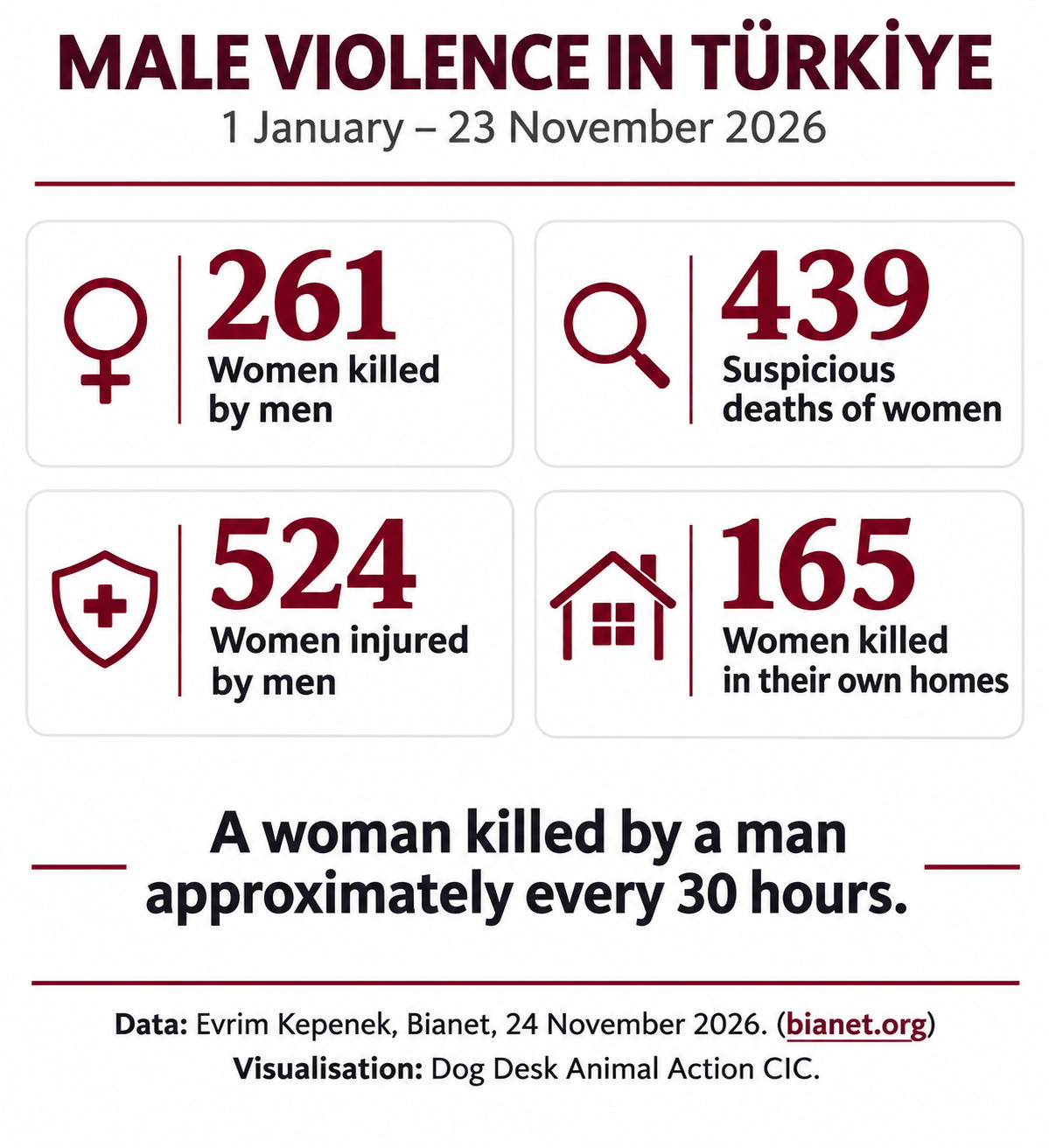
Behind every number is a woman whose life had value beyond the circumstances of her death. A woman with relationships, ambitions, people who loved her and a future she should have been entitled to live.
The We Will Stop Femicide Platform, an independent Turkish women’s rights organisation, has also spent years documenting femicide and suspicious deaths.
Recorded femicides and suspicious deaths in Türkiye
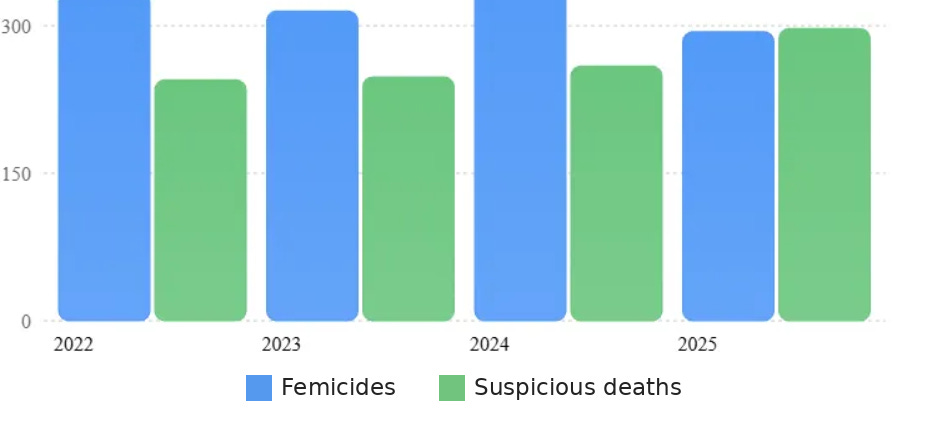
Data: We Will Stop Femicide Platform, annual reports 2022–2025. The 2024 report contains a discrepancy of one suspicious death; its published headline figure of 259 is used here.
The number of suspicious deaths recorded in 2025 exceeded the number of documented femicides. While a suspicious death cannot automatically be classified as a killing, establishing what happened to those women remains essential to understanding the true extent of violence and identifying potential failures in protection.
When violence happens behind closed doors
One of the most disturbing aspects of the figures published by Bianet is the relationship between the women killed and their perpetrators.
Approximately three quarters were killed by men with whom they had shared intimate relationships.
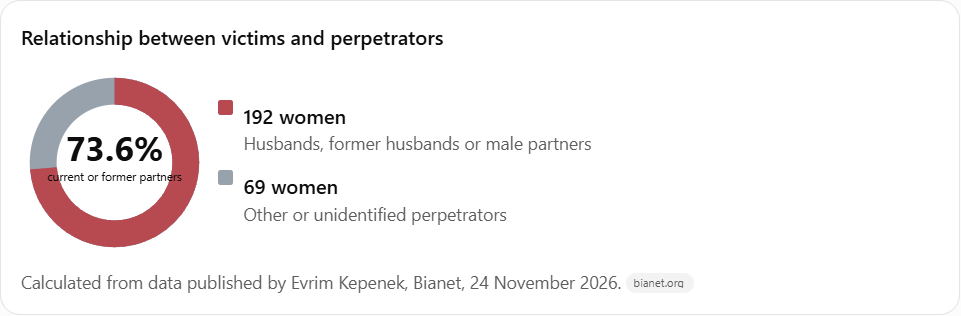
For many women, the greatest danger does not come from a stranger in the street but from someone with whom they have shared a home, a family and the intimate details of their lives.
It is within these environments that we must also consider the vulnerability of animals.
An animal living in an abusive household has no means of reporting violence, requesting protection or independently escaping the person responsible for its suffering. Its dependence upon the people around it can be exploited by someone who recognises that hurting the animal is also a means of hurting a woman.
What happens to animals within abusive households in Türkiye? How often are they threatened, injured or killed? How often is their suffering deliberately inflicted to intimidate or punish another member of the household?
And who is recording it?
Violence against animals in Türkiye cannot be ignored
Over the course of our work in Türkiye, we have become increasingly concerned not only by the severity of violence inflicted upon animals but also by the extent to which its perpetrators are held accountable.
We are an organisation that deals with the consequences of animal cruelty. The suffering does not end when an act of violence is over. There are animals left with permanent disabilities, animals requiring months of reconstructive surgery and rehabilitation, and animals whose fear of human beings can take years to overcome.
Beyond the animals who reach organisations like ours are those whose suffering is never discovered, whose injuries are never treated and whose deaths are never investigated.
Since the introduction of Türkiye’s amended street animal legislation in July 2024, allegations of serious cruelty have emerged from municipal facilities across the country. Animal protection defenders have documented disturbing scenes, challenged official explanations and demanded investigations.
In October 2024, journalist Tuğçe Yılmaz reported for Bianet on the discovery of dead animals outside a municipal rehabilitation facility in Gebze. Subsequent reporting documented disputed explanations for their deaths and the announcement of judicial and administrative investigations.
Our own reporting at Dog Desk Animal Action has repeatedly examined the treatment of animals following their removal from the streets, the transparency of municipal operations and the difficulties involved in establishing what has happened to individual dogs.
But violence against animals in Türkiye extends far beyond municipal facilities and street dog policy.
We must also consider the violence taking place in private homes, on private land and in communities where witnesses may be unwilling or afraid to report what they have seen.
The deliberate torture of an animal is an act of violence in its own right. It does not acquire significance only when we discover that its perpetrator has also harmed a human being. Nevertheless, understanding the wider behaviour of those who deliberately inflict suffering upon animals could be of considerable importance to safeguarding.
If someone is capable of deliberately inflicting extreme suffering upon a defenceless animal, what consideration is given to the safety of the other vulnerable lives around that individual?
Animal cruelty as an instrument of power
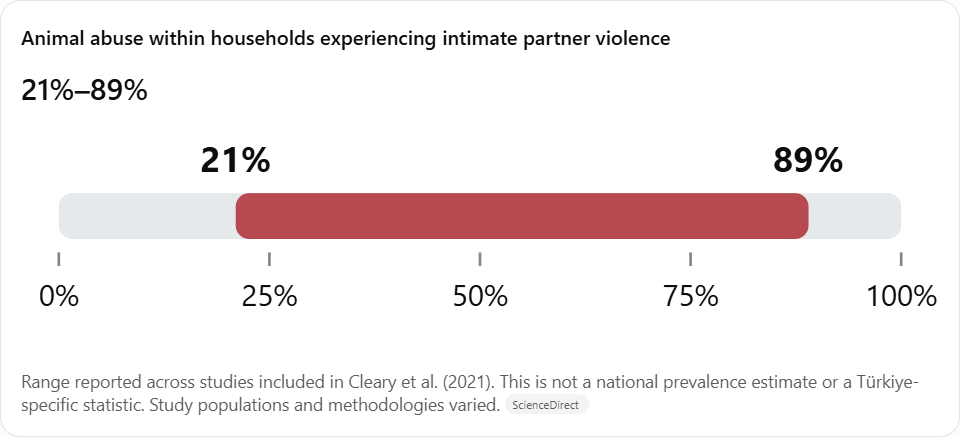
The animal may become an instrument through which the perpetrator exercises power. Its suffering may be deliberately inflicted to punish a woman for challenging her abuser, to intimidate her into compliance or to prevent her from leaving.
A woman does not necessarily have to witness the violence for it to achieve its intended purpose. Knowing what someone is capable of doing to an animal she loves may be enough to control her behaviour.
For the animal, there is no understanding of why it is being hurt. There is only the experience of pain, fear and an inability to escape.
For the woman, there is the additional psychological burden of knowing that someone is prepared to deliberately hurt another living being in order to hurt her.
The consequences can be particularly serious when a woman attempts to leave an abusive relationship. If refuge accommodation cannot accommodate her animals, she may face the prospect of leaving them with the very person from whom she is trying to escape.
In these circumstances, animal protection becomes an important component of protecting women.
What is being recorded in Türkiye?
Türkiye’s own national statistics provide further context concerning violence that may never become visible to the authorities.
The Turkish Statistical Institute’s 2024 Violence Against Women Survey found that almost half of the women covered by its findings on disclosure of partner violence had not told anyone about the most recent incident.
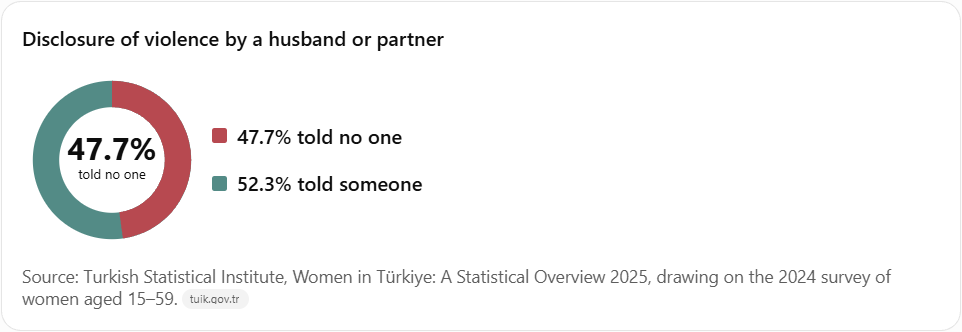
If violence against women can remain undisclosed to anyone outside the abusive circumstances in which it occurs, what are the implications for animals living within those same households?
An animal cannot disclose its abuse to a friend, a family member, a doctor or a police officer. Its suffering may only become known if someone witnesses an incident, recognises an injury or identifies a pattern of behaviour that raises concern.
This places considerable importance on the people who encounter animals outside their homes, particularly veterinary professionals.
When an animal is presented with an unexplained injury, is there a mechanism through which concerns about deliberate cruelty can be raised? Where cruelty is suspected, is consideration given to the possibility that other members of the household may also be experiencing violence?
We have yet to establish the extent to which these questions form part of safeguarding practice in Türkiye.
The consequences of impunity
One of our longstanding concerns in Türkiye is what happens after an act of animal cruelty has been reported.
Public outrage frequently follows the publication of footage showing animals subjected to extreme violence. Social media fills with demands for justice, appeals are made to the authorities and, in some cases, investigations are announced.
But public outrage is not a substitute for accountability.
Was the perpetrator identified? Was a prosecution brought? What was the outcome? Were restrictions imposed on that individual’s future access to animals? Was there any wider assessment of the risk posed by their behaviour?
These questions should be just as important after public attention has moved elsewhere.
International research gives us legitimate grounds to consider animal cruelty as a potential indicator of interpersonal violence. That does not mean every person who harms an animal will subsequently harm a woman, nor does it mean that every perpetrator of domestic violence has a history of animal cruelty.
It does mean that there is sufficient evidence to question whether investigating acts of animal cruelty in complete isolation could result in important warning signs being overlooked.
We do not need to demonstrate that every act of animal cruelty will lead to human suffering before taking violent behaviour towards animals seriously.
The animal is already a victim. The violence has already occurred. The need for intervention already exists.
Violence and the streets of Türkiye
The relationship between public violence towards animals and violence within private households deserves separate consideration.
The international academic research examining animal cruelty within domestic abuse cannot simply be applied to municipal dog killings or other forms of organised violence against street animals. These involve different circumstances, motivations and systems of responsibility.
Nevertheless, the visibility of violence against animals in Türkiye raises important questions about attitudes towards cruelty, the enforcement of animal protection legislation and the consequences of failing to hold perpetrators accountable.
What happens to public perceptions of animal suffering when acts of extreme cruelty are repeatedly witnessed without visible consequences? Does exposure to such violence influence attitudes towards animals? Does the way violence is discussed, justified or challenged affect the likelihood of people intervening when they witness it?
These are questions that require research in their own right.
We have documented serious concerns about the treatment of animals in Türkiye, and we will continue to do so. We will also examine whether there is evidence of a wider relationship between exposure to animal cruelty, attitudes towards violence and interpersonal abuse.
The distinction between what we have documented and what we are investigating is important. It is what allows us to pursue these questions with credibility.
Protection must extend beyond legislation
Türkiye withdrew from the Istanbul Convention in July 2021. Domestic legislation intended to protect women from violence remains in place, including Law No. 6284, but women’s rights organisations have repeatedly challenged the effectiveness of its implementation.
The We Will Stop Femicide Platform has highlighted concerns about women being killed despite existing protective measures and has called for stronger enforcement of domestic protections.
There are parallels with our concerns about animal protection, particularly in relation to the difference between the existence of legislation and its practical application.
An animal protection law cannot protect an animal if its suffering goes unreported, if an allegation is not investigated or if the person responsible faces no meaningful consequences.
Effective safeguarding requires more than legislation. It requires accessible reporting mechanisms, competent investigations, appropriate intervention and a system capable of recognising when violence may extend beyond the victim who initially came to its attention.
Solidarity between movements
In its 2024 annual femicide report, Türkiye’s We Will Stop Femicide Platform also addressed the country’s street animal legislation and expressed solidarity with animal protection defenders.
It is significant that this recognition came from within Türkiye’s women’s rights movement.
There is considerable value in the exchange of knowledge between organisations working to protect women and those working to protect animals. Veterinary professionals, domestic abuse specialists, social workers, animal protection defenders and criminal justice professionals may each encounter different aspects of violence occurring within the same household.
Yet if those experiences are recorded separately, examined separately and acted upon separately, opportunities to identify the wider circumstances of abuse may be lost.
Collaboration does not require either movement to abandon its own priorities. It requires recognition that some victims may be living under the control of the same perpetrator and that their protection may be interconnected.
The questions we will be investigating
As part of our continuing research into violence against animals in Türkiye, Dog Desk Animal Action will be examining the following areas:
Whether histories of animal cruelty have been identified among perpetrators of femicide and domestic violence.
Whether threats against animals are recognised within Turkish domestic abuse risk assessments.
Whether women escaping violence can access safe accommodation or temporary fostering arrangements for their animals.
Whether veterinary professionals receive training in recognising potential domestic abuse.
Whether animal cruelty investigations consider the safety of other vulnerable members of a household.
The outcomes of animal cruelty investigations, including prosecutions, convictions and penalties.
Whether information is shared between animal protection and human safeguarding services.
What Turkish academic research exists concerning the relationship between animal cruelty, exposure to violence and interpersonal abuse.
We also want to examine the experiences of Turkish animal protection defenders and veterinary professionals, whose work may bring them into contact with circumstances that have received insufficient attention within formal research.
We must establish not only what is known, but what is not being recorded and what the absence of that information means for the protection of vulnerable lives.
Violence does not exist in isolation
Today, on White Ribbon Day, we remember the women whose lives have been stolen through violence. We recognise the courage of those who continue to live under its threat and stand in solidarity with the organisations working tirelessly to protect them.
As an animal protection organisation, we also have a responsibility to examine the wider implications of the violence we encounter through our work.
We know that animals are being subjected to appalling cruelty in Türkiye. We know that women are being subjected to violence. International research has established circumstances in which these forms of abuse intersect, yet the extent of that relationship in Türkiye remains insufficiently understood.
We want to know whether warning signs are being missed, whether animal cruelty is being adequately investigated and whether greater recognition of its relationship with interpersonal violence could help prevent future suffering.
The animal being beaten behind closed doors may not be the only victim in that home. The woman attempting to escape violence may be carrying the additional burden of knowing that an animal she loves remains in danger.
Neither should be invisible.
No woman should have to choose between her own safety and the safety of an animal she loves. And no act of deliberate cruelty should be considered insignificant simply because its victim cannot speak.
Sources and Further Reading
Evrim Kepenek, Bianet – Male violence monitoring, 24 November 2026
Tuğçe Yılmaz, Bianet – Animal deaths in Gebze, 11 October 2024
Bianet – Announcement of investigations following the Gebze animal deaths
Turkish Statistical Institute – Türkiye Violence Against Women Survey 2024
Turkish Statistical Institute – Women in Türkiye: A Statistical Overview 2025
Academic research
This article brings together published evidence and Dog Desk Animal Action’s analysis of animal protection, violence and safeguarding. It forms the starting point of our continuing research into the relationship between animal cruelty and interpersonal violence in Türkiye.
Support and information
If you are experiencing domestic abuse, or are concerned about someone who may be experiencing violence, specialist support is available. Abuse is not limited to physical violence. Threats, intimidation, coercive control and threats to harm animals are also serious concerns.
Support in Türkiye
Emergency services – 112: If you are in immediate danger.
ALO 183: Free, 24-hour social support helpline.
KADES: An emergency mobile application for women experiencing or threatened with violence.
ŞÖNİM: Violence Prevention and Monitoring Centres offering specialist advice and support.
Federation of Turkish Women’s Associations: Domestic violence helpline – 0212 656 96 96 or 0549 656 96 96.
Further information: UNHCR Türkiye – Seeking help and reporting violence.
Support in the United Kingdom
Emergency services: 999.
England – Refuge: 0808 2000 247.
Wales – Live Fear Free: 0808 80 10 800.
Scotland – Domestic Abuse and Forced Marriage Helpline: 0800 027 1234.
Northern Ireland – Domestic and Sexual Abuse Helpline: 0808 802 1414.
Support for people escaping domestic abuse with animals in the UK
Specialist organisations provide temporary fostering arrangements for animals while their families seek safety.
Dogs Trust Freedom – specialist dog fostering.
Cats Protection Lifeline – specialist cat fostering.
The Links Group – information and signposting to specialist animal fostering services.
International support
Lila.help provides an international directory of organisations supporting people experiencing gender-based violence.
If you are concerned that someone is monitoring your online activity, consider accessing support using a safe device.
Everyone deserves to live free from violence, intimidation and fear.