


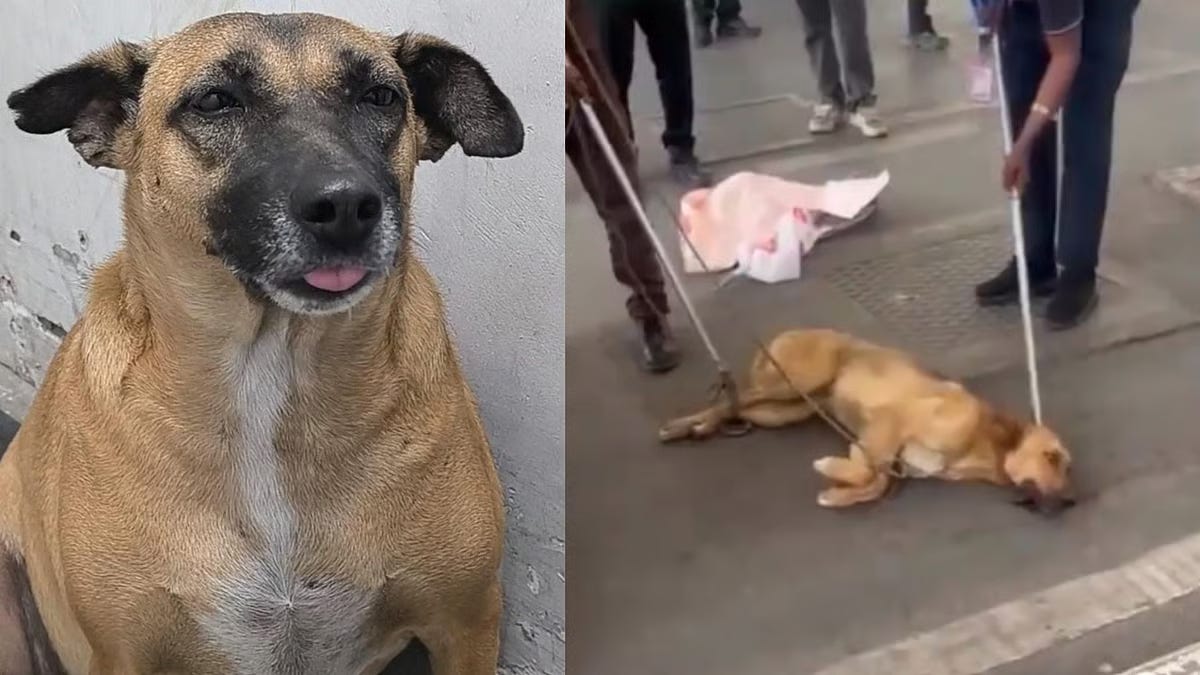
A new controversy has emerged in India, one that exposes a familiar fault line in global dog policy.
At the centre of it are a group of community dogs who had lived for years at Delhi Airport. Sterilised. Vaccinated. Known.
And now gone.
The Incident
Viral videos and activist testimony allege that long-standing community dogs were forcibly removed from the airport environment.
These were not unknown animals.
They were dogs who had reportedly lived in the area for over a decade, dogs who had already been through sterilisation programmes and were part of a managed street population.
One elderly dog, described as a permanent fixture for 13–14 years, has not been seen since late March.
Footage circulating online appears to show dogs being unloaded in a weakened, disoriented condition, raising concerns about sedation and handling during capture.
Activists have described the situation bluntly:
Loss of territory. Loss of stability. Loss of protection.
What the Law Says
India does not treat all stray dogs as disposable. Under established animal welfare guidelines, sterilised and vaccinated street dogs are meant to be returned to the same location after treatment.
This is not just a welfare principle, it is a population management strategy.
Remove them, and you create instability:
New, unsterilised dogs move in
Territorial conflict increases
Human-dog tension escalates
The cycle resets
Relocation is not neutral. It is disruptive by design.
The Justification: Public Safety
Airport authorities have responded. They allege multiple dog bite incidents over 30 reported within three months and specific cases of aggressive behaviour toward passengers.
From their perspective, the priority is clear, passenger safety. And this is where the debate hardens. Because both things can be true at once:
Poorly managed environments can create risk
Poorly executed removal creates harm
The question is not whether safety matters. It is how it is achieved.
The Pattern We Keep Seeing
This is not an isolated incident. It is a pattern. Across countries, across systems, across political approaches:
Dogs are tolerated until they are not
Pressure builds (media, incidents, public complaints)
Rapid removal follows
Welfare protections are bypassed or stretched
The problem returns, often worse
Short-term clearance is repeatedly mistaken for long-term control.
The Reality for the Dogs
For a community dog, territory is everything. It is:
Where they find food
Where they understand the risks
Where they have social structure
Where they are tolerated
Remove that, and you remove their survival framework. For older dogs, especially, relocation is often a death sentence in slow motion. Not through violence. Through disorientation, competition, and decline.
What This Case Really Exposes
This is not just about Delhi Airport. It is about a deeper global issue. When systems prioritise visibility over stability, dogs become expendable.
Sterilisation programmes are presented as humane solutions but their effectiveness depends entirely on one condition:
Return to territory. Remove that, and the entire framework collapses.
Where Responsibility Sits
This situation should not be reduced to outrage alone. There are responsibilities on all sides:
Authorities must operate within welfare law not around it
Welfare systems must be properly resourced not symbolic
Infrastructure planning must account for animal populations not react to them
Advocacy must remain grounded in facts not escalation
Because when any one of these fails, the outcome is predictable. And the dogs carry the cost.
The Question That Remains
If sterilised, harmless, long-term community dogs can be removed from protected environments what protection actually exists?