


How we portray animals in public communications says something about our relationship with them, and perhaps something about ourselves.
There is something deeply uncomfortable about watching a real tragedy become entertainment.
On 10 October, 23-year-old William Chapman lost his life following an encounter with an Amur tiger named Altai at Yorkshire Wildlife Park. It was a devastating incident for his family, for those who witnessed it and for everyone involved.
In the days that followed, footage of the incident circulated online. US President Donald Trump shared footage of the attack on his Truth Social account and subsequently published an AI-generated video depicting himself playfully wrestling with a tiger.
Before going any further, we want to make something clear. Dog Desk Animal Action has no interest in party politics, political allegiance or the political views of those involved. Our concern is with animal welfare, public education and the responsibility we all share when representing animals, particularly when those representations arise from real incidents involving suffering or loss of life.
William Chapman’s family have spoken publicly about the distress caused by the circulation of material relating to his death. Their wishes deserve respect. We will not reproduce the footage or the AI-generated video here.
When a person loses their life in an encounter with a wild animal, two things should be possible at once. We should be able to recognise the terrible loss of human life and extend compassion to those left behind, while also recognising that the animal involved is a living being whose behaviour deserves to be understood rather than sensationalised.
Yet increasingly, events involving animals are reduced to moments of spectacle. Footage circulates, images are shared, jokes are made and, before long, the original circumstances become almost secondary to the attention the material attracts.
Artificial intelligence has added another dimension to this. We can now take real events and transform them into fictional scenes within seconds. An encounter that ended in tragedy can be recreated as comedy, an animal can be made to behave in ways entirely contrary to its nature, and something that should encourage reflection can become another piece of disposable entertainment.
At Dog Desk Animal Action, we spend a great deal of time examining how people perceive animals, particularly those whose behaviour brings them into conflict with human communities.
An animal portrayed as dangerous, aggressive or threatening may be judged long before anyone considers the circumstances of its behaviour. Equally, presenting a powerful wild animal as a harmless plaything can create a misleading impression of what that animal is and how humans should interact with it.
Neither portrayal serves the animal particularly well.
Wild animals are not actors in a human drama. They do not understand the narratives we construct around them, the attention their images attract or the humour people may find in their behaviour. They respond to their environment through instincts, experiences and biological needs that deserve respect. And when something goes terribly wrong, the consequences are real.
Behind the headlines there may be a family whose life has changed forever. There may also be an animal whose future becomes uncertain because of an encounter it could never understand in human terms. Those realities should not disappear simply because a video has the potential to attract an audience.
This raises a wider question about responsibility. We have become accustomed to sharing material almost without thinking. Something catches our attention, provokes a reaction and is passed along to thousands of other people. The speed of that process leaves very little room to consider whether the content is accurate, what it communicates about animals or how it might affect those directly involved.
Not everything that can be created or attracts attention deserves to be published or amplified.
That does not mean difficult incidents should be hidden from public view. Quite the opposite. Responsible reporting can help us understand animal behaviour, examine safety measures, identify failures and consider how similar tragedies might be prevented.
We can discuss a fatal encounter without turning the animal into a monster. We can acknowledge the extraordinary power of a wild predator without pretending it is a cuddly companion. And we can recognise the loss of a human life without making that loss the foundation of a joke.
Perhaps the most troubling aspect of all this is how easily the seriousness of an event can disappear once it becomes content. A few seconds of amusement may seem inconsequential to the person watching, but the tragedy from which that amusement was created remains very real to somebody else.
Animal welfare is not confined to veterinary treatment, rescue or legislation. It also involves the attitudes we encourage and the understanding we help create.
How we speak about animals influences how we treat them. How we represent them influences how others perceive them. And how we respond when their lives intersect tragically with ours reveals something about the value we place on both human and animal life.
A tragedy should be an opportunity to learn, to understand and, where necessary, to prevent another one. It should not have to become entertainment.
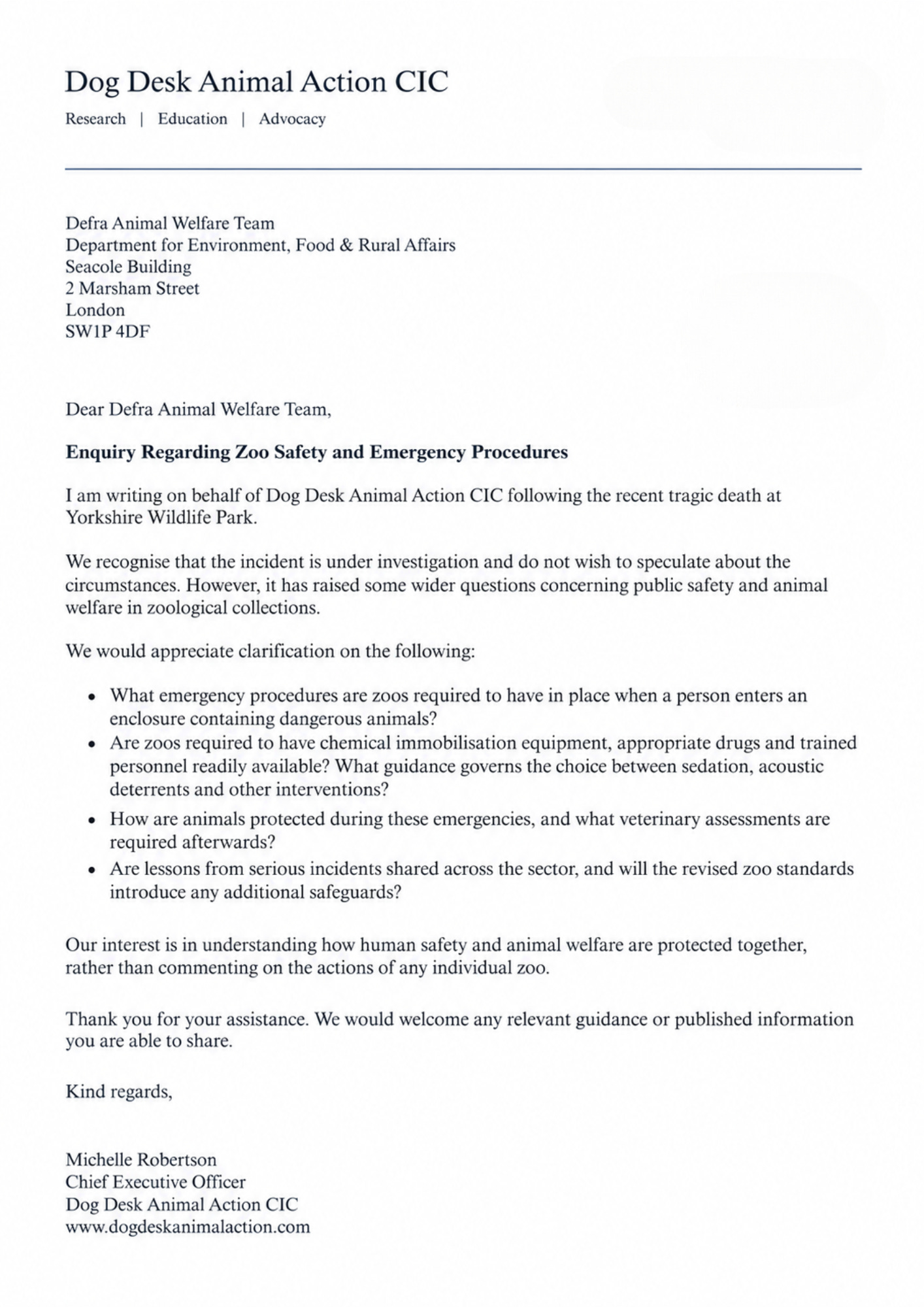
Following this tragedy, Dog Desk Animal Action has written to Defra seeking clarification on the safety measures required in British zoos, particularly the emergency procedures in place when a person enters an enclosure housing dangerous animals.
Our enquiry also addresses the availability of chemical immobilisation, the use of non-lethal interventions and the protection of animals during such incidents. We have asked how lessons from serious incidents are shared across the sector to help prevent future tragedies. Our intention is not to speculate about what happened at Yorkshire Wildlife Park, but to better understand how human safety and animal welfare are protected together. We will share Defra’s response when it is received.
It wasn’t a tragedy. There was nothing tragic about the idiots killing.
Anthony andCleopatras deaths were tragic.
Crassus's death at the hands of the Parthians, was tragic.
Achilles.
Napolean’s defeat at Waterloo, even.
Robespierre’s.
But not this.