


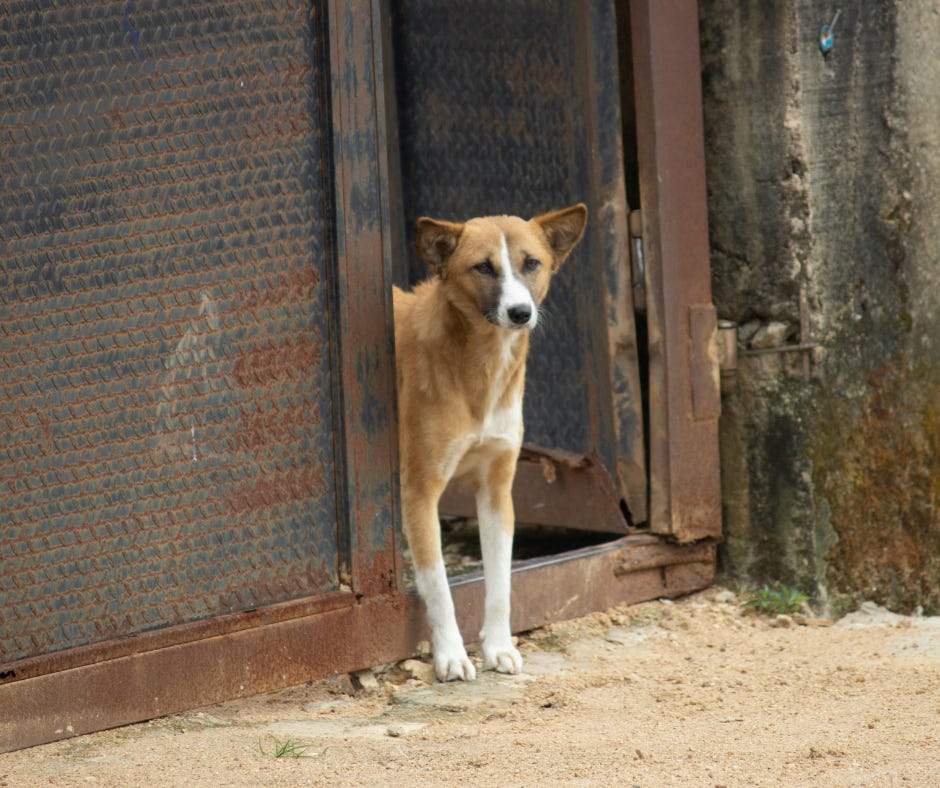
Animal welfare emergencies demand an immediate response. Dogs need food. Injured animals need veterinary treatment. Outbreaks of disease need controlling. Animals in immediate danger need somewhere safe to go. When the crisis is happening in front of us, responding to it is not optional. But what happens when the emergency never ends?
If an organisation, municipality or country has been responding to essentially the same animal welfare emergency for five years, ten years or twenty years, it becomes reasonable to ask whether what began as an emergency response has quietly become the system itself.
Across the world, enormous amounts of money, time and human effort are spent dealing with the consequences of unmanaged dog populations. Dogs are collected from streets. Shelters expand. New shelters are built. Food is purchased. Veterinary bills are paid. Volunteers rescue animals. Charities fundraise to keep them alive. Municipalities award contracts for collection, transport, kennelling or long term care. Then, as one group of dogs moves through the system, another arrives behind them.
The work can be relentless, expensive and absolutely necessary. But necessity should not prevent us from asking why it remains necessary on such a scale.
An emergency response is supposed to deal with an exceptional situation while longer term measures address its causes. When the same response has to be repeated year after year, something upstream is not working.
That does not mean abandoning the dogs who need help today in favour of some distant policy ambition. A dog hit by a car cannot wait for legislation. A starving dog cannot wait for a national sterilisation programme to begin producing results. A shelter operating beyond capacity cannot simply close its doors because prevention would have been preferable.
We have to do both.
The problem begins when almost all available energy and resources remain concentrated at the point where the crisis becomes visible. By then, the dog has already been born. The litter has already appeared. The dog has already been abandoned. The population has already grown. The disease has already spread. The shelter is already full. The municipality is already under pressure to act. At that point, the available choices become narrower, more expensive and frequently worse for the dogs.
Prevention happens much earlier.
It means sustained sterilisation at sufficient scale rather than occasional campaigns. It means vaccination before disease becomes an emergency. It means responsible ownership systems that are actually enforced. It means identification and registration where those systems can improve traceability. It means tackling abandonment rather than simply collecting the animals who have been abandoned. It means examining breeding and the continued production of dogs while existing animals have nowhere to go. It means understanding where dogs are coming from, why populations are changing and which interventions are actually reducing the number of animals entering crisis.
Most importantly, it means measuring outcomes rather than activity.
A municipality may report how many dogs it collected. A shelter may report how many animals it received. An organisation may report how many dogs it fed or treated. Those figures tell us something about the work being done, but they do not necessarily tell us whether the underlying problem is getting smaller.
If 10,000 dogs are collected this year and another 10,000 need collecting next year, collection has managed the consequence. It has not necessarily changed the cause.
The same question should be asked of rescue.
Rescue saves individual lives and will always matter. Dog Desk Animal Action knows that very well. There are dogs alive because somebody intervened when the systems around them failed. But the existence of rescue should never become an excuse for those systems to continue failing.
There is a danger in becoming exceptionally good at managing failure.
Shelters can become larger. Rescue networks can become more efficient. Fundraising can become more sophisticated. Municipal collection systems can become faster. Contracts can become bigger. Entire infrastructures can develop around dealing with unwanted, abandoned and free roaming dogs.
Eventually, thousands of people may depend upon keeping that machinery moving. Yet the most important measure of success should surely be whether fewer dogs need that machinery at all.
That requires uncomfortable questions about where resources are going. How much is being spent repeatedly responding to the consequences of the problem? How much is being invested in preventing those consequences? Are interventions being evaluated over years rather than celebrated through short term numbers? Are dog populations actually falling in a humane and sustainable way? Are fewer dogs entering shelters? Are fewer being abandoned? Are fewer puppies being born into circumstances in which their survival depends upon rescue? And if not, why not?
There will always be emergencies in animal welfare. Accidents happen. Disease outbreaks occur. People encounter hardship. Animals are abandoned despite laws and education. No prevention system will remove every dog from danger. But permanent emergency should not become an accepted model of animal welfare.
When the same crisis returns every year, we should stop treating recurrence as inevitable. The question is no longer simply how many dogs we can rescue, collect, shelter or feed.
The question becomes why we are still having to do it at the same scale. Emergency intervention saves the dog standing in front of us today. Good policy should mean there are fewer dogs standing there tomorrow.