
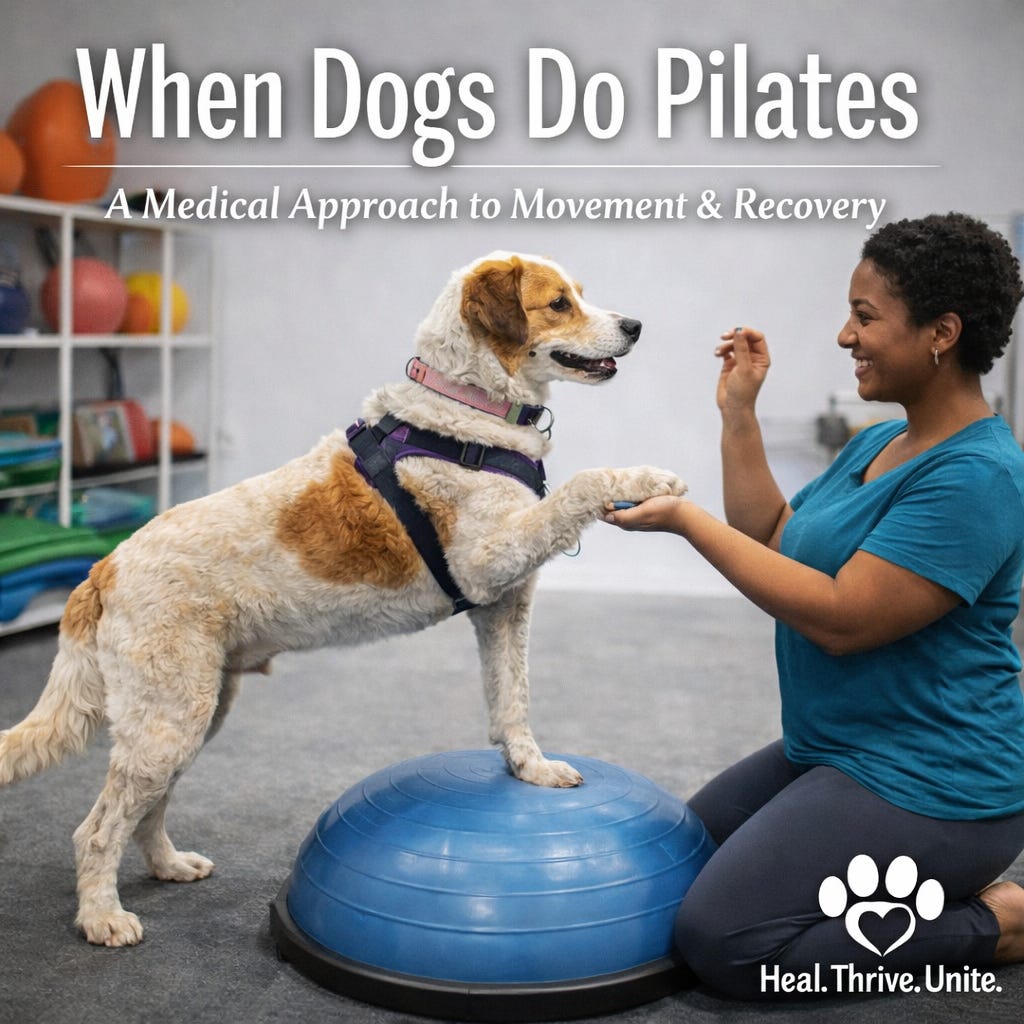
The idea of dogs doing Pilates might still sound unusual.
Images of dogs balancing on cushions can easily be mistaken for novelty or trend.
But that interpretation misses what is really happening.
Because in veterinary medicine, Pilates is not a trend.
It is becoming part of how dogs are treated, rehabilitated, and helped to move again without pain.
Pilates is already widely used in human healthcare.
It is prescribed for:
injury recovery
post-surgical rehabilitation
chronic pain management
neurological conditions
The focus is not on exercise for its own sake, but on:
controlled movement
core stability
alignment
rebuilding strength safely
Veterinary professionals are now applying these same principles to dogs.
What Pilates Looks Like for a Dog
In a clinical setting, it may not always be labelled as Pilates.
But the structure is recognisable.
Dogs are guided through:
slow stepping exercises
balance work on unstable surfaces
assisted standing and weight shifting
Each movement is deliberate.
Each repetition has a purpose.
This is not about keeping a dog busy or entertained. It is about retraining the body.
Why This Is Needed
Dogs come into veterinary rehabilitation for many reasons:
orthopaedic surgery
arthritis and age-related decline
trauma
long-term compensation from untreated pain
By this stage, movement is no longer efficient or balanced.
Muscles weaken. Joints become unstable. The body adapts in ways that create further strain.
Without structured intervention, recovery is often incomplete.
Precision Over Force
This is where Pilates-based principles become important.
They allow rehabilitation to focus on:
small, controlled movements instead of force
stability before strength
correct movement patterns rather than compensation
gradual progression based on the individual dog
A dog balancing on a cushion is not performing.
They are rebuilding core strength and joint stability.
A Clinical Shift
This reflects a broader shift in veterinary care.
Treatment is no longer limited to:
medication
surgery
rest
It now includes active rehabilitation.
Movement itself has become part of the treatment plan.
And that movement is no longer random it is structured, intentional, and increasingly influenced by methods like Pilates.
What This Means for Dogs in Rescue
For dogs coming out of shelters, the streets, or traumatic injury, this matters enormously.
Many of these dogs have adapted to injury over time.
They have learned to move around discomfort rather than through it.
Rehabilitation helps undo that.
A More Accurate Way to See It
It is not quite right to say dogs do Pilates in the same way humans do.
But it is also no longer correct to say they do not need it.
Because what we call Pilates has moved beyond fitness.
It has become:
a method of restoring movement where it has been lost
And in that sense, it absolutely has a place in veterinary care.
The Takeaway
This is not about trends or humanising dogs. It is about recognising something important:
When movement breaks down, it has to be rebuilt carefully.
Pilates offers a framework for doing that and veterinary medicine is beginning to use it.
Not as a novelty. But as part of how dogs heal.


