
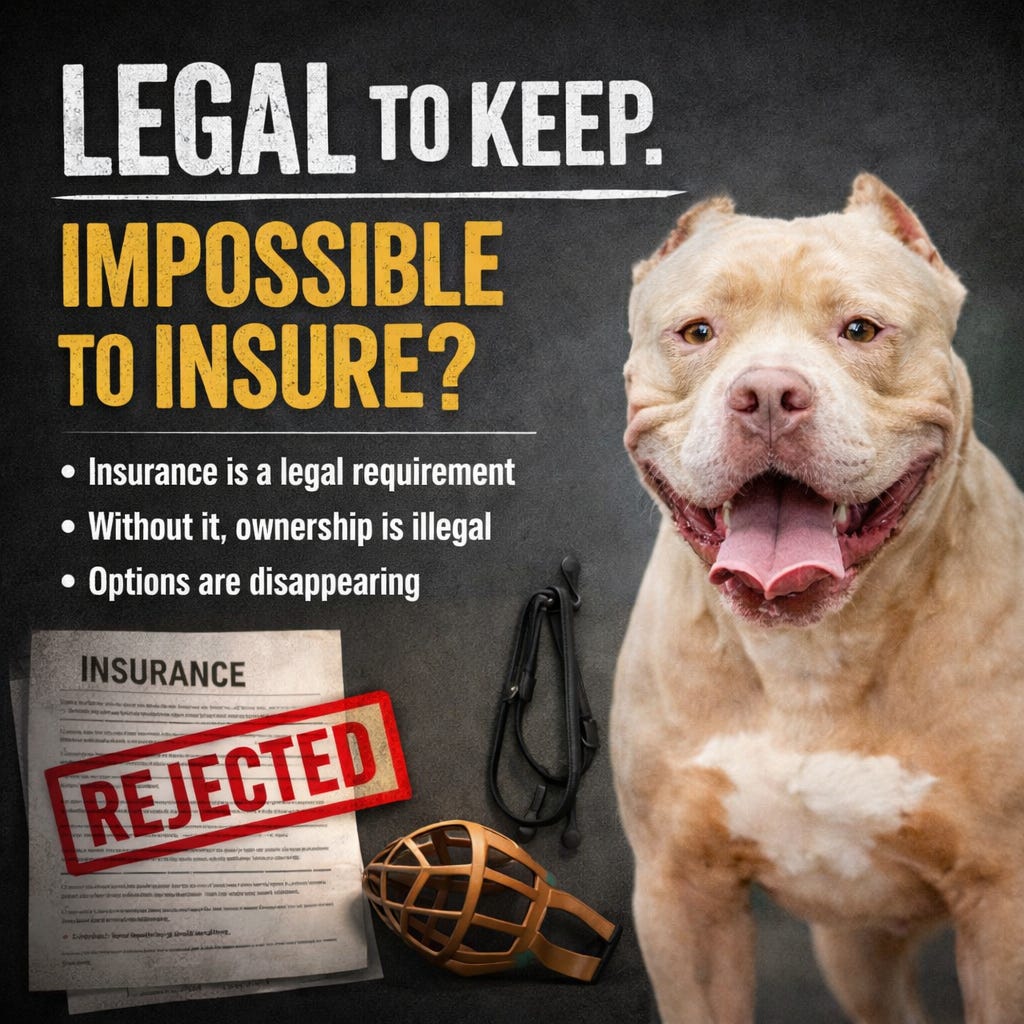
When Legal Ownership Becomes Practically Impossible: Dogs Trust Withdraws Insurance for XL Bully Dogs
A quiet policy change with significant consequences
From 1 July 2026, Dogs Trust will remove third-party public liability insurance from its Companion Club scheme.
On the surface, this appears administrative. In practice, it removes one of the most accessible routes for owners to meet a legal requirement tied directly to ownership of an exempt XL Bully dog.
Why this matters more than it seems
Under UK law, XL Bully dogs can only be kept if strict exemption conditions are met.
One of those conditions is not optional:
valid third-party public liability insurance must be in place at all times.
For many owners, Dogs Trust provided a straightforward, affordable way to meet that obligation. With that route now closing, the issue is no longer theoretical. It becomes practical.
Legal requirement: insurance is not optional
To legally keep an XL Bully dog in England and Wales, owners must comply with all exemption conditions under the Dangerous Dogs Act framework.
These include:
Registration on the Index of Exempted Dogs
Microchipping
Neutering within the required timeframe
Muzzling and keeping the dog on a lead in public
Secure containment
Maintaining valid third-party public liability insurance
If insurance lapses or cannot be obtained, the exemption conditions are breached.
The consequence is clear:
The dog is no longer legally kept under the exemption.
This can lead to seizure and potential destruction, even where the original owner intended to comply.
The emerging reality: legality without access
The legal framework has not changed.
But access to compliance is narrowing:
Many mainstream insurers exclude banned breeds
Available policies are often specialist, costly, or restrictive
One of the most widely used charity-backed options is now being withdrawn
This creates a structural tension:
The law requires insurance.
The market is reducing access to it.
When compliance becomes unattainable
This is where policy shifts into consequence.
Owners unable to secure insurance are left with limited choices:
Attempt to locate specialist cover
Fall into non-compliance
Surrender their dog
Face the possibility of euthanasia
The law remains intact but the ability to follow it does not.
The pressure shifts to the individual
The XL Bully exemption model places responsibility on owners to meet every condition.
With insurance options shrinking, that responsibility intensifies. Compliance is no longer simply about willingness.
It becomes dependent on availability.
The welfare implications
When legal compliance becomes difficult to maintain, predictable outcomes follow:
Increased abandonment risk
Owners delaying action due to uncertainty
Greater strain on rescue systems
Dogs existing in legal instability
These are not failures of individual intent. They are systemic outcomes.
A policy question that remains unanswered
The intention of the legislation is public safety. But effective policy depends on infrastructure:
Insurance availability
Clear compliance pathways
Realistic access for ordinary owners
When those supports begin to withdraw, a gap appears between law and reality.
Closing reflection
The withdrawal of insurance by Dogs Trust is not the core issue. It is an indicator.
A sign that the mechanisms enabling legal ownership are beginning to contract.
And when that happens, the burden does not fall on policy frameworks.
It falls on dogs and on the people trying to remain within the law as the path narrows around them.


