


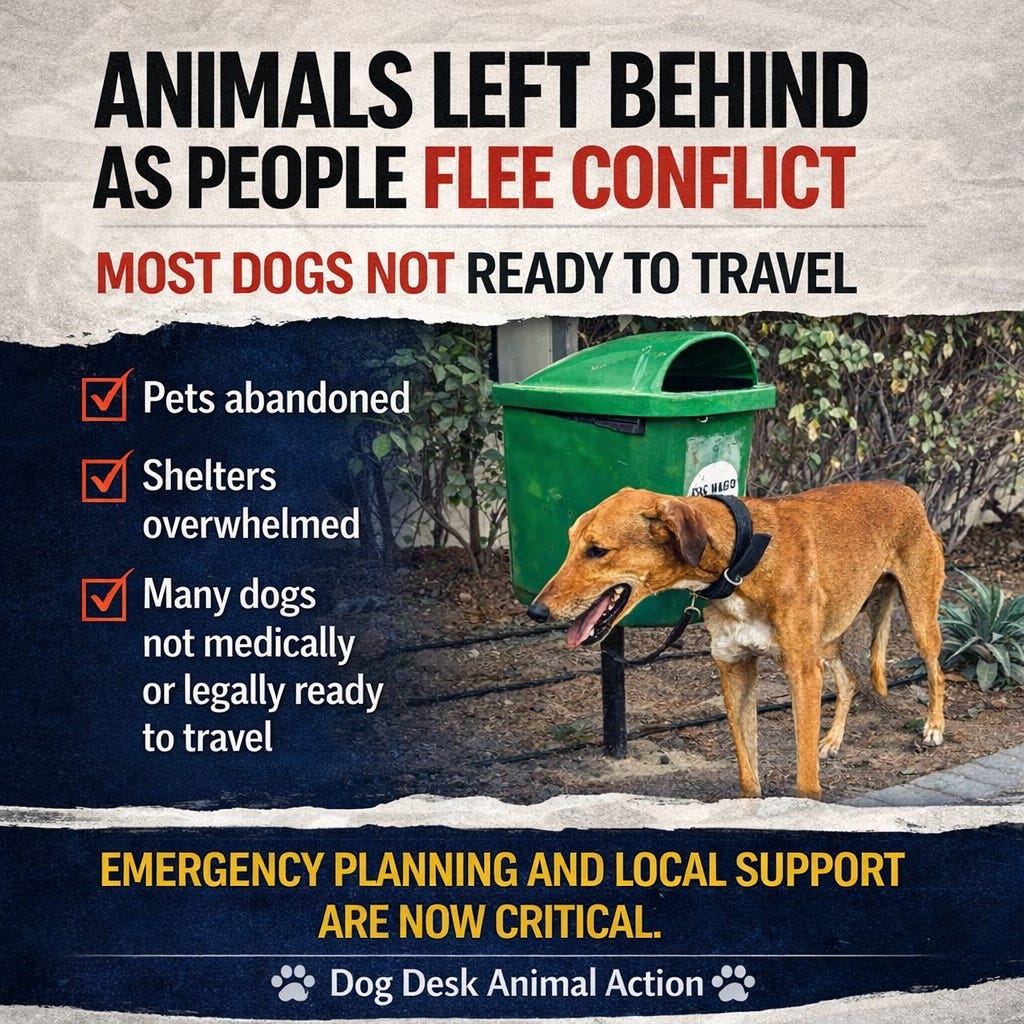
In recent weeks a quiet but increasingly urgent situation has been unfolding in Dubai.
As expatriate residents prepare to leave the United Arab Emirates, some are discovering that their dogs and other pets cannot legally travel with them, at least not immediately.
For some animals, the paperwork is incomplete. For others, the medical requirements are not yet satisfied.
And in many cases, the timelines simply do not align with the departure dates of their owners.
The result is a growing number of pets temporarily stranded in the country while their families depart.
For the animals involved, it is a deeply uncertain moment.
Requests for Help
Animal welfare organisations are already beginning to receive requests for assistance.
Dog Desk Animal Action has also been contacted about several cases involving pets whose owners are preparing to leave Dubai while their animals are still waiting to become legally eligible for travel.
Unfortunately, we do not have the operational resources required to coordinate international evacuations or large-scale relocation efforts.
In response, our director Michelle has reached out to trusted partner organisations who specialise in disaster aid and evacuations from high-risk environments, including conflict zones, to alert them to the situation and explore whether they may be able to provide advice or support where possible.
These specialist organisations have experience navigating complex international animal transport logistics under difficult circumstances.
Their knowledge may prove valuable as this situation develops.
A System Built on Strict Compliance
International pet travel is governed by a web of veterinary, aviation and customs regulations.
To legally leave the UAE, pets must meet several mandatory requirements:
A microchip compliant with international standards
Up-to-date vaccination records, including rabies
A veterinary health certificate
A government export permit issued by the Ministry of Climate Change and Environment
These documents confirm that the animal is healthy, traceable and legally authorised to travel.
Even when all paperwork is correct, the process must be carefully timed.
The export health certificate is typically valid for only a limited period, meaning the animal must travel within that window.
Many destination countries also impose waiting periods after rabies vaccination or require additional tests before entry.
When these timelines collide with job transfers, visa deadlines or emergency relocations, problems begin.
When Humans Move Faster Than Paperwork
Dubai is a city built on international mobility.
Millions of residents are expatriates whose employment contracts, visas and housing arrangements can change quickly. When relocation happens suddenly, pets are sometimes left navigating a slower bureaucratic system.
A dog may need:
a new rabies vaccination
a mandatory waiting period
additional blood tests or documentation
airline cargo arrangements
Each step takes time.
Owners may be forced to board flights while their animals remain behind waiting for compliance with destination country rules.
Temporary Guardianship Networks
In response, informal support networks often emerge.
Veterinary clinics, relocation services and animal welfare volunteers sometimes step in to help care for animals until travel documents are ready.
Some pets are boarded in veterinary clinics or pet hotels.
Others are temporarily fostered by friends or volunteers.
These arrangements are usually made quickly and quietly simply to ensure the animal is safe until its owner can arrange transport.
But they rely heavily on goodwill and personal connections.
A Reminder of Preparation
The situation unfolding in Dubai is not a crisis born of cruelty.
It is largely the result of bureaucracy colliding with human mobility.
International pet travel requires preparation, paperwork and precise timing. When relocation happens suddenly anywhere, animals can become caught between borders.
For expatriate pet owners, the lesson is simple: start the process early to avoid risk.
For animal welfare organisations, the reality is also clear: animals in transit still need care.
Behind every relocation story is a dog waiting for the next flight and the reunion that follows.
😢😢 very sad indeed