

When Street Dogs Meet House Dogs
Observations on differing developmental environments

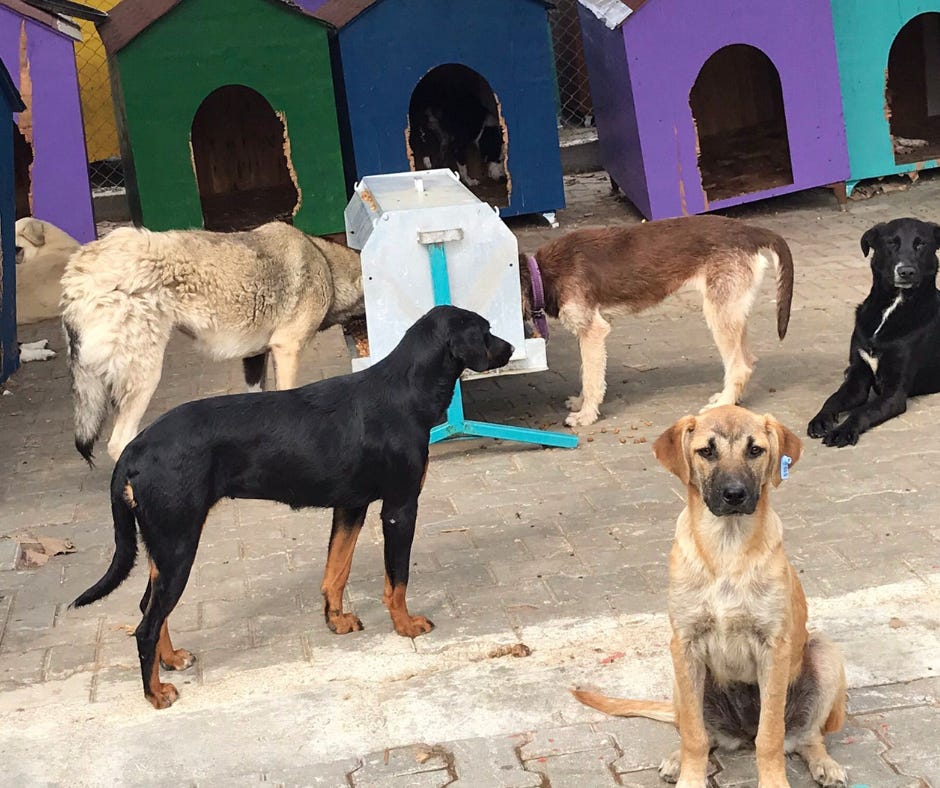
In shelters and sanctuary environments where dogs from different backgrounds are brought together, behavioural contrasts can sometimes become visible very quickly.
One of the most noticeable differences occurs when dogs raised on the street encounter dogs raised primarily inside human homes, particularly those bred and purchased as companion animals.
In mixed groups, street-born dogs often appear to recognise that these newcomers behave differently within a canine social context. The response is rarely dramatic, but subtle shifts in observation, spacing, and interaction style can be seen.
These observations raise an interesting question: how strongly does a dog’s developmental environment shape the way it communicates with other dogs?
Developmental Environments
Free-roaming and street-born dogs grow up within socially complex canine environments. From an early age they are surrounded by multiple unrelated adult dogs and changing social groupings.
Within these environments, young dogs are exposed to:
fluid social hierarchies
shared territories and feeding areas
frequent encounters with unfamiliar dogs
varying levels of human presence and intervention
Behavioural flexibility becomes important for avoiding conflict and maintaining access to resources.
Observational studies of free-roaming dog populations suggest that these dogs develop strong abilities in reading and responding to subtle social signals within dog groups. These signals include posture, gaze direction, body orientation, and the management of physical distance.
Dogs raised primarily within human households develop under different conditions.
Their early social environment is typically structured around:
a small number of familiar humans
limited numbers of known dogs
managed encounters during walks or play
predictable feeding and resting routines
In these contexts, many social interactions are mediated or interrupted by humans. As a result, the dog’s primary communication framework often becomes human-directed rather than dog-group oriented.
These differences do not indicate better or worse development. They reflect two distinct learning environments.
Initial Encounters
When dogs from these backgrounds are brought together in shelter environments, the differences sometimes become visible during initial encounters.
Street-born dogs frequently pause to observe unfamiliar dogs before approaching. They may maintain larger initial spacing and rely on indirect movement patterns such as curved approaches.
Dogs raised primarily in homes may show different patterns, including:
more direct approaches
sustained eye contact
closer physical proximity during initial interaction
orientation toward nearby humans when uncertainty arises
Street-born dogs tend to rely less on human intervention during canine interactions, instead adjusting their own positioning or withdrawing from the encounter if necessary.
Again, none of these behaviours are problematic in isolation. They simply reflect different social learning histories.
Spatial Awareness and Social Negotiation
One area where these differences can be particularly noticeable is spatial negotiation.
In environments where many dogs share space, the management of distance becomes an important communication tool. Street dogs often display fluid adjustments in spacing, altering body orientation or movement direction to signal intention without escalation.
Dogs with less experience navigating large canine groups may initially misinterpret or overlook some of these signals. For example, direct approaches or prolonged eye contact may unintentionally create tension in environments where indirect movement and brief signalling are more typical.
Street-born dogs frequently respond to this uncertainty by slowing interactions, increasing observation time, or temporarily maintaining distance.
Behavioural Plasticity
Importantly, dogs are behaviourally adaptable.
House-raised dogs can learn to navigate multi-dog environments over time, just as street-born dogs can learn to live successfully within human households.
However, the speed and ease of this adaptation varies between individuals and is influenced by factors such as age, previous experience, and temperament.
The key point is that dogs do not enter new environments without history. Each dog brings with it a set of behavioural expectations shaped by its early experiences.
Dogs Raised in Dog Societies vs Dogs Raised in Human Societies
One useful way to interpret these behavioural differences is through the concept of social environment.
Free-roaming and street-born dogs are raised primarily within what could be described as dog societies. Their daily interactions involve multiple unrelated dogs with whom they must share space, negotiate access to resources, and interpret a wide range of social signals.
Within these environments, young dogs gain extensive experience observing and participating in canine communication. Social learning occurs through repeated exposure to group behaviour, including affiliative interactions, avoidance signals, and conflict management.
Dogs raised primarily within human households develop within a different type of social structure, one that could reasonably be described as human societies.
Their interactions are largely mediated by people. Humans often regulate encounters with other dogs, determine access to resources, and intervene when tension arises. As a result, the dog’s social experience becomes strongly oriented toward human communication and guidance.
Both environments produce well-adapted dogs for their respective contexts. However, they cultivate different behavioural expectations.
Dogs raised in canine social systems tend to rely heavily on subtle body signals and spatial negotiation when interacting with unfamiliar dogs. Dogs raised within human-managed environments may rely more on human cues or may initially have less experience navigating large groups of unfamiliar dogs.
When these two developmental pathways intersect in shelters or sanctuaries, the contrast in social strategies can sometimes become visible in the way dogs approach, observe, and respond to one another.
Understanding these differences is important when interpreting behaviour during introductions or transitions between environments.Observation Before Interaction
One behavioural pattern frequently seen in free-roaming dogs is a period of observation before engagement.
When unfamiliar dogs enter a shared space, street-born dogs often pause to watch rather than approaching immediately. During this time they appear to assess posture, movement patterns, gaze direction, and the general confidence or uncertainty of the newcomer.
This behaviour can be understood as a form of risk assessment.
In environments where dogs must coexist without human supervision, misinterpreting another dog’s intentions can lead to conflict or injury. Pausing to observe allows dogs to gather information before committing to a social interaction.
I have noted that these animals frequently rely on subtle behavioural cues such as body orientation, tail carriage, pacing patterns, and changes in speed or direction to interpret social intentions.
Observation provides time to process these cues.
Dogs raised primarily within human households may not display this same pattern of delayed engagement. In many domestic environments, interactions with other dogs occur in structured settings such as controlled walks, supervised play sessions, or organised socialisation.
Because humans often intervene when tensions arise, the need for prolonged assessment may be reduced.
As a result, some house-raised dogs may approach unfamiliar dogs more directly or with less preliminary observation. In mixed environments such as shelters, this difference in interaction style can sometimes lead street-born dogs to pause longer before engaging.
From a behavioural perspective, this pause is not hesitation or insecurity. It is often an adaptive strategy developed in environments where accurate social interpretation is essential.
Observation Before Interaction
One behavioural pattern frequently seen in free-roaming dogs is a period of observation before engagement.
When unfamiliar dogs enter a shared space, street-born dogs often pause to watch rather than approaching immediately. During this time they appear to assess posture, movement patterns, gaze direction, and the general confidence or uncertainty of the newcomer.
This behaviour can be understood as a form of risk assessment.
In environments where dogs must coexist without human supervision, misinterpreting another dog’s intentions can lead to conflict or injury. Pausing to observe allows dogs to gather information before committing to a social interaction.
Researchers studying free-ranging dogs have noted that these animals frequently rely on subtle behavioural cues such as body orientation, tail carriage, pacing patterns, and changes in speed or direction to interpret social intentions.
Observation provides time to process these cues.
Dogs raised primarily within human households may not display this same pattern of delayed engagement. In many domestic environments, interactions with other dogs occur in structured settings such as controlled walks, supervised play sessions, or organised socialisation.
Because humans often intervene when tensions arise, the need for prolonged assessment may be reduced.
As a result, some house-raised dogs may approach unfamiliar dogs more directly or with less preliminary observation. In mixed environments such as shelters, this difference in interaction style can sometimes lead street-born dogs to pause longer before engaging.
From a behavioural perspective, this pause is not hesitation or insecurity. It is often an adaptive strategy developed in environments where accurate social interpretation is essential.
Conclusion
From a behavioural perspective, encounters between street-born dogs and house-raised dogs highlight the role of early social environments in shaping canine communication.
Free-roaming dogs develop within multi-dog societies where reading posture, movement, and distance is essential. Dogs raised primarily within human households develop within a different social framework, one that often prioritises human interaction over canine group negotiation.
When these two developmental histories meet in shelter environments, the differences may become visible in approach patterns, spatial awareness, and interaction pacing.
Careful observation of these interactions helps us better understand how dogs adapt to new environments and why transitions between street, shelter, and home sometimes require time and thoughtful management.