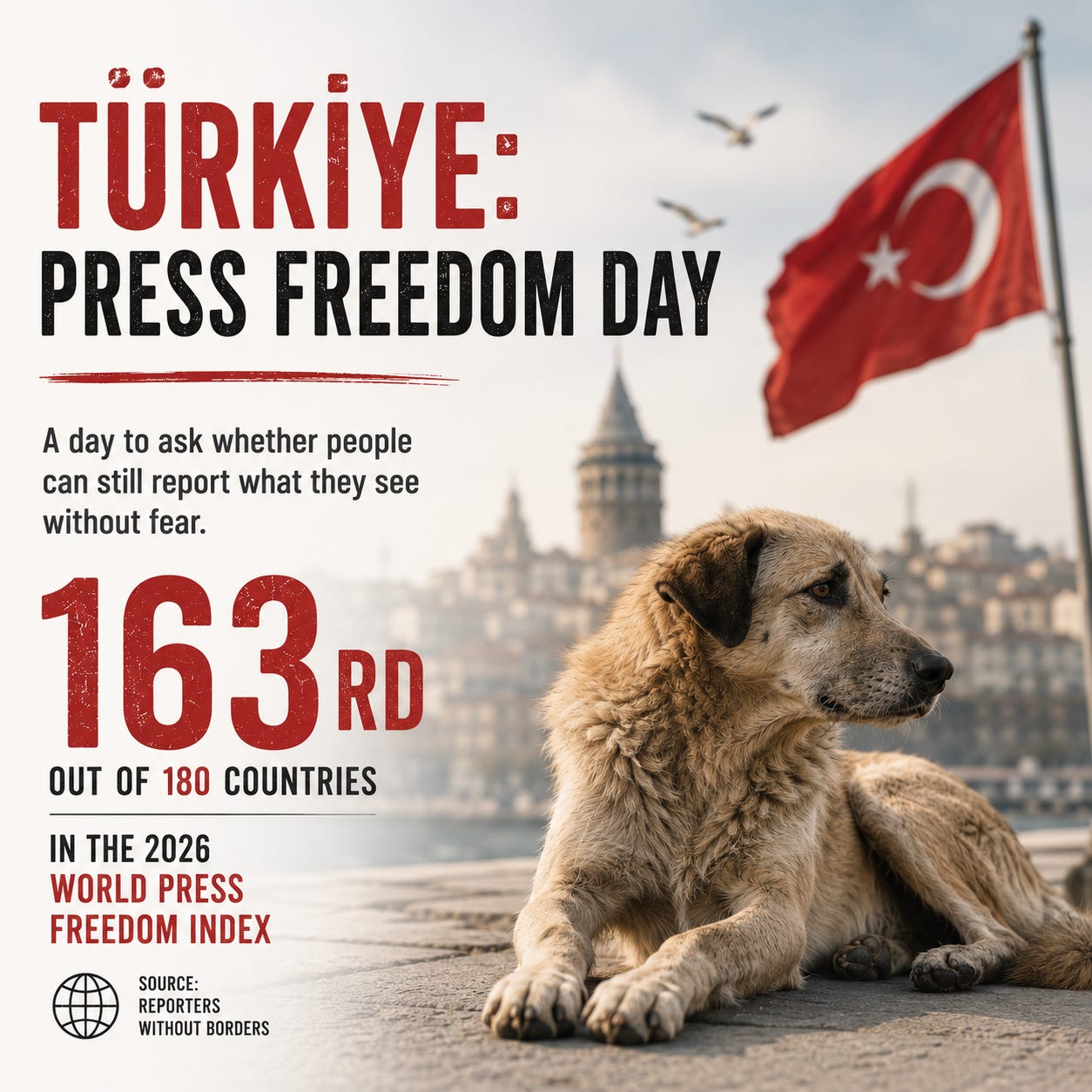
Today, 24 July, Türkiye marks a day associated with journalists and press freedom, a date rooted in 1908 when censorship of the press was lifted following the restoration of constitutional rule in the Ottoman Empire. More than a century later, however, this should not simply be a day to look backwards and commemorate a freedom won. It should be a day to look at the reality facing those trying to exercise that freedom now.
Because press freedom means very little if people are free to report only what is comfortable.
Türkiye enters this 24 July with journalists still facing detention, prosecution and imprisonment, independent media working under considerable pressure and the country sitting at 163rd out of 180 countries in the 2026 World Press Freedom Index. Behind that ranking are journalists who have found themselves before courts, behind bars or facing restrictions because of their work, alongside others who have left the country and continued reporting from abroad.
It is difficult to reconcile that reality with a day dedicated to press freedom, but perhaps that contradiction is precisely why 24 July continues to matter.
The true measure of a free press has never been whether newspapers can publish ordinary news or whether journalists can report stories nobody objects to. Freedom is tested when the story is uncomfortable, when the questions are difficult, when somebody in authority would prefer those questions were not being asked and when what a journalist discovers challenges the version of events already placed before the public.
At Dog Desk Animal Action we are not a Turkish news organisation, but our work means that we follow events across Türkiye closely, particularly those affecting the country’s free roaming dogs. Local journalism is an important part of that work. It helps us understand what is happening in towns and cities hundreds of miles apart, follow municipal decisions, examine statements made by public officials and identify incidents that may otherwise never travel beyond the communities in which they occurred.
Sometimes what is being reported is deeply uncomfortable. We have followed allegations concerning conditions inside shelters, questions surrounding the collection and handling of dogs, footage emerging from the streets, concerns raised by rescuers, protests against municipal practices and disputes over what has happened to animals after they have been removed. We have also reported the responses of municipalities and officials when those responses have been available.
We take enormous care with that work. An allegation remains an allegation unless evidence establishes otherwise. Where something cannot be independently verified, we say so. We distinguish between what we know, what somebody has reported and what remains unanswered. That is not hesitation. It is part of the responsibility that comes with publishing information which may have serious implications.
There will always be uncomfortable questions when public authorities exercise power, and Türkiye’s street dogs are now living through a period in which municipal authorities have been given extraordinary responsibility for what happens to them. Dogs are being collected from public spaces across the country and taken into systems that the public must be able to scrutinise. Whatever someone’s position on Türkiye’s stray dog policy, transparency should not be controversial.
If a dog disappears after collection, people should be able to ask where that dog went. If disturbing footage emerges, somebody should be able to investigate it. If conditions inside a facility are questioned, journalists should be able to look. If official statements and accounts from people on the ground appear to conflict, reporters should be able to ask why. And if everything has been done properly, scrutiny provides the opportunity to demonstrate exactly that.
This is why press freedom reaches far beyond politics. It reaches into municipal buildings, courtrooms, hospitals, prisons and, yes, animal shelters. Anywhere that institutions exercise power over those with less power, the ability of somebody independent to look, question and report matters.
For animals, that scrutiny can be particularly important because they cannot provide their own testimony. A dog cannot tell a journalist what happened after the municipal vehicle disappeared around the corner. It cannot describe the conditions behind the walls of a shelter. It cannot challenge an official statement, request records or ask why nobody has seen it since the day it was collected.
Somebody else has to look. Sometimes that person is a rescuer standing outside a shelter gate. Sometimes it is a volunteer, a lawyer, a campaigner or an ordinary member of the public who refuses to stop asking questions. And sometimes it is a journalist.
That is why today we stand in solidarity with journalists in Türkiye who continue to do their jobs, particularly those prepared to investigate the stories that are difficult to tell. We remember those who have been detained, prosecuted or imprisoned, those who have faced restrictions because of their work and those who have felt they could no longer continue that work from inside their own country.
24 July should not become a comfortable annual celebration of a battle supposedly won in 1908. Freedom of the press is not something a country wins once and keeps forever. It exists only for as long as people remain free to investigate, question, document and publish without fear of what asking those questions might cost them.
More than a century after censorship was supposedly consigned to history, that principle remains worth defending. Because when something happens behind a shelter wall, down a quiet street in the middle of the night, inside a public institution or anywhere else those responsible would rather nobody looked, somebody must still be able to look. And somebody must still be free to tell us what they found.


