


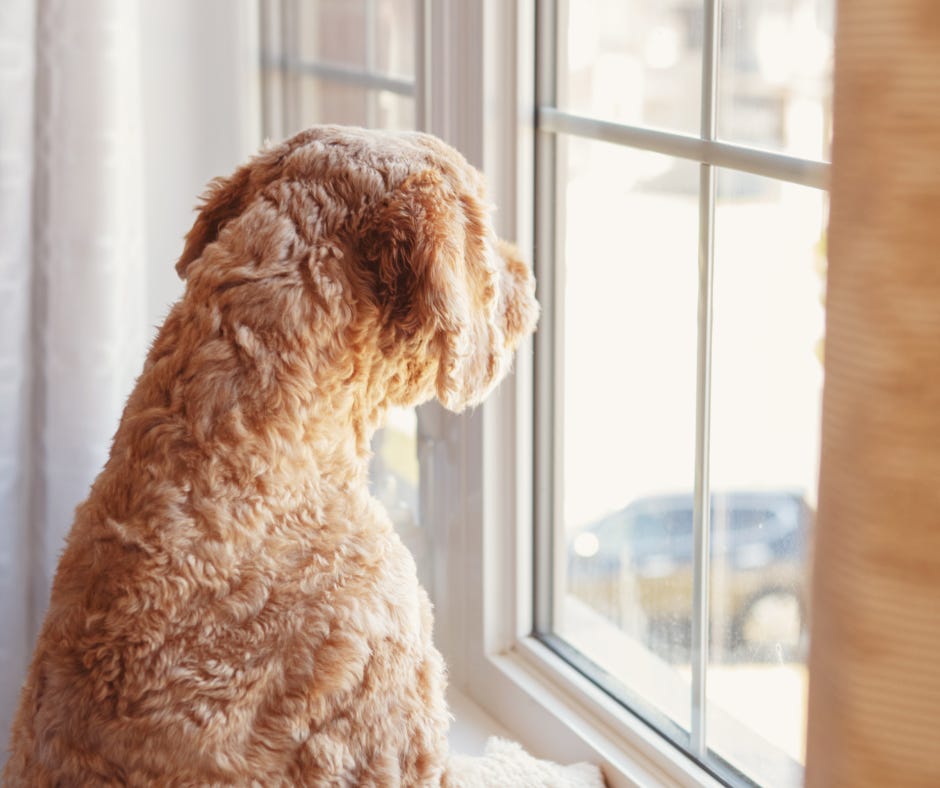
One of the most common questions people ask about dogs is this, Do they know we are coming back when we leave?
It is an understandable question. Humans plan their days around the expectation of return. We leave for work knowing we will come home later. We leave a room knowing we will walk back in again.
But dogs do not experience time in the same way that we do.
Research in canine cognition suggests that dogs do not form future-oriented plans in the way humans do. Their mental world is largely organised around immediate experiences, emotional associations, and learned patterns rather than abstract concepts of tomorrow or later.
This leads to an interesting possibility.
When we leave the house, our dogs may not know that we will return.
Instead, they may simply experience our absence.
Dogs and the Concept of Time
Humans understand time through clocks, calendars, and long-term memory. Dogs do not possess this same cognitive framework.
Studies in canine cognition indicate that dogs perceive time primarily through changes in environmental cues. These include:
light levels throughout the day
household sounds
routines such as feeding or walking
scent patterns within the home
One study from researchers at the University of Pisa showed that dogs greet their owners with greater enthusiasm after longer absences. This suggests that they can detect elapsed time, but not necessarily predict future events.
In other words, dogs may recognise that someone has been gone for a long time, but that does not mean they understand that the person will return.
The Role of Routine
If dogs do not anticipate our return in the human sense, why do most dogs remain calm when their owners leave?
The answer is learning and pattern recognition.
Dogs are extremely good at identifying repeating sequences:
shoes being put on
keys being picked up
doors opening and closing
the quiet period that follows
Over time, they learn that these events are usually followed by the owner reappearing.
But this is not the same as a conscious prediction.
Instead, it is closer to probability based learning. Dogs become accustomed to a pattern in which departures are temporary.
When routines are stable, this pattern provides reassurance. When routines change suddenly, some dogs experience stress because the pattern they rely on has been disrupted.
Absence as a Social Event
Dogs are a social species. Their evolutionary history is rooted in living within cooperative groups.
In social animals, separation can carry real meaning.
Among wolves and free-living dogs, individuals who leave the group do not always return. Separation can indicate temporary absence, but it can also indicate permanent loss.
Domestic dogs still carry this social wiring.
For some dogs, particularly those who are strongly bonded to their caregivers, a departure may therefore be experienced simply as separation from the group, without any guarantee that reunion will occur.
Why Some Dogs Struggle More Than Others
Most dogs cope well with normal household absences. Others show signs of distress, including:
pacing
vocalisation
destructive behaviour
house soiling
attempts to escape
These behaviours are commonly described as separation anxiety, though the underlying mechanisms vary.
Several factors appear to influence how dogs respond to human absence:
early life experiences
attachment style
stability of daily routines
environmental enrichment in the home
previous experiences of abandonment or rehoming
Dogs who have experienced sudden loss or unstable environments may be more sensitive to separation events.
What Dogs May Actually Learn
Over time, many dogs learn something simpler than my owner will come back.
They learn that absence does not last forever.
This subtle distinction matters.
Dogs do not necessarily anticipate the future return in a conceptual sense. Instead, they gradually become comfortable with the experience of waiting.
For stable dogs in secure homes, this waiting becomes a normal part of daily life.
A Different Way of Thinking About It
From a human perspective, leaving the house is a temporary interruption in the day.
From a dog’s perspective, it may simply be the moment when their social partner disappears.
They remain in the environment where they last saw us, surrounded by our scent and the familiar structure of the home.
Eventually, we walk back through the door.
Whether or not they predicted that moment, the reunion is real every time.
And perhaps that is why it still matters so much to them.
Really interesting, enjoyed this, made me think.