



For the first time, veterinary practices in the UK are being required to publish their prices.
Prescription fees are also being capped, with written prescriptions limited to £21 for the first item and £12.50 for additional medications.
These changes are being presented as progress. But they also raise a more fundamental question. Why did it take regulatory intervention to introduce basic transparency into a system responsible for animal health?
What The Regulator Found
The Competition and Markets Authority did not introduce these changes lightly.
Its investigation identified a market where competition is limited, ownership is increasingly concentrated among a small number of large corporate groups, and prices have risen by around 63% between 2016 and 2023, well above inflation.
More importantly, it found that owners were often not given clear information on costs or alternatives.
In some cases, pricing decisions were made with the expectation that owners would not question them or switch providers. This is the context in which transparency is now being enforced.
When There Is No Clarity, Decisions Drift
This is not theoretical, we saw it ourselves.
Bella presented with diarrhoea and vomiting that did not resolve. She was admitted to the vet and underwent a series of tests across the day. None provided a clear answer.
From experience working with dogs in a shelter environment, the presentation was familiar. I asked whether it could be giardia.
That suggestion did not come from guesswork. It came from repeated exposure to the same symptoms in high-density dog populations, where giardia is common.
Bella was eventually tested & she was positive.
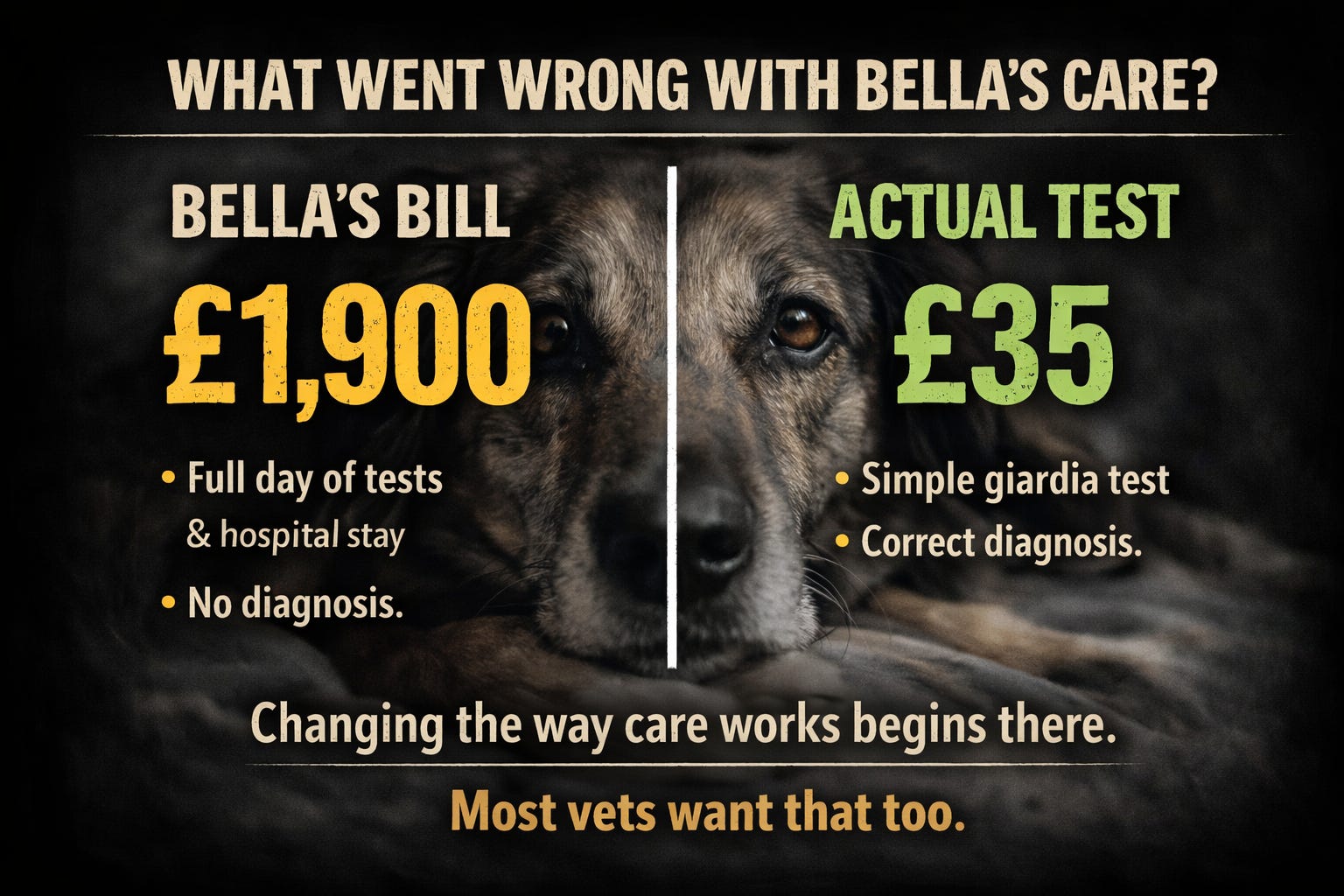
A simple snap test costing in the region of £12–£35 would have confirmed this at the outset. Treatment is straightforward and relatively inexpensive.
Instead, we received a bill of £1,900.
Multiple tests. A full day of hospitalisation. No clear diagnosis until the most obvious route was finally taken at my request. No upfront explanation. No structured pathway. No visibility on cost versus likelihood.
Only the final bill which I might add includes both a consultation fee and an examination fee!
Why Transparency Matters
Bella recovered but the point is not the outcome. It is the process. Without transparency, decisions are not necessarily wrong but they are unstructured, unclear, and difficult to challenge.
Owners are placed in a position where:
They do not know what tests cost
They do not know what alternatives exist
They do not know the likelihood of each diagnostic pathway
They are not equipped to weigh cost against probability
So they agree. Because when your dog is unwell, you do not negotiate. You comply.
The CMA’s findings confirm that this is not an isolated experience. It is a systemic issue.
Rising Costs And Real-World Consequences
Veterinary costs have risen sharply in recent years not gradually, but at a pace many would describe as astronomical. We are now seeing the consequences.
Owners are being pushed to the edge financially. Some delay treatment. Some make impossible decisions. And some, increasingly, abandon.
At the same time, rescue organisations already operating at capacity are absorbing the fallout and struggling with rising prices too.
This is not abstract. It is happening now.
Respect For Vets And How Decisions Should Work
It is important to be clear. We work with exceptional veterinarians. Some we trust implicitly. Some we consider family.
The vets we work with consistently explain treatment options, likely outcomes, and whether something is necessary or not.
That clarity matters. Wally is one example.
He lost an eye following a severe beating as a pup. There was an option to fit a silicone orbital implant, a cosmetic procedure that would make the empty socket appear more natural as it healed. Without it, the area can gradually sink, leaving a visible hollow.
But this was not a medical necessity. It was cosmetic.
Given our responsibility to use limited resources where they have the greatest impact, we chose not to proceed. That decision was made with full information, clear explanation, and an understanding of both outcome and cost.
While this is a cosmetic example, the same principle applies across all treatment decisions. Clarity allows prioritisation.
Without it, that balance is much harder to achieve.
Corporate Ownership And System Change
This is not about individual vets.
But in our view, the shift towards large-scale corporate ownership has changed how the system operates. The CMA’s findings reflect this, pointing to market concentration and weakened competition.
Alongside this, advances in diagnostics have brought real benefits. The ability to investigate complex conditions is greater than ever before.
But availability does not always equal necessity. Bella is a clear example of that.
What The Changes Are Trying To Do
The introduction of price lists, ownership disclosure, and prescription caps is an attempt to correct the imbalance.
In theory, it should mean:
Clearer pricing before treatment begins
Greater ability to compare between providers
Awareness that medication can be sourced elsewhere
A shift towards more informed decision-making
These are basic expectations in most sectors. They are only now being formalised in veterinary care.
What This Does Not Resolve
Transparency does not automatically prevent over-treatment. It does not ensure that the most likely diagnosis is prioritised first.
And it does not remove the imbalance that exists when an owner is making decisions under pressure, often without the knowledge to challenge clinical direction.
It simply creates the conditions where better decisions can be made.
Final Thought
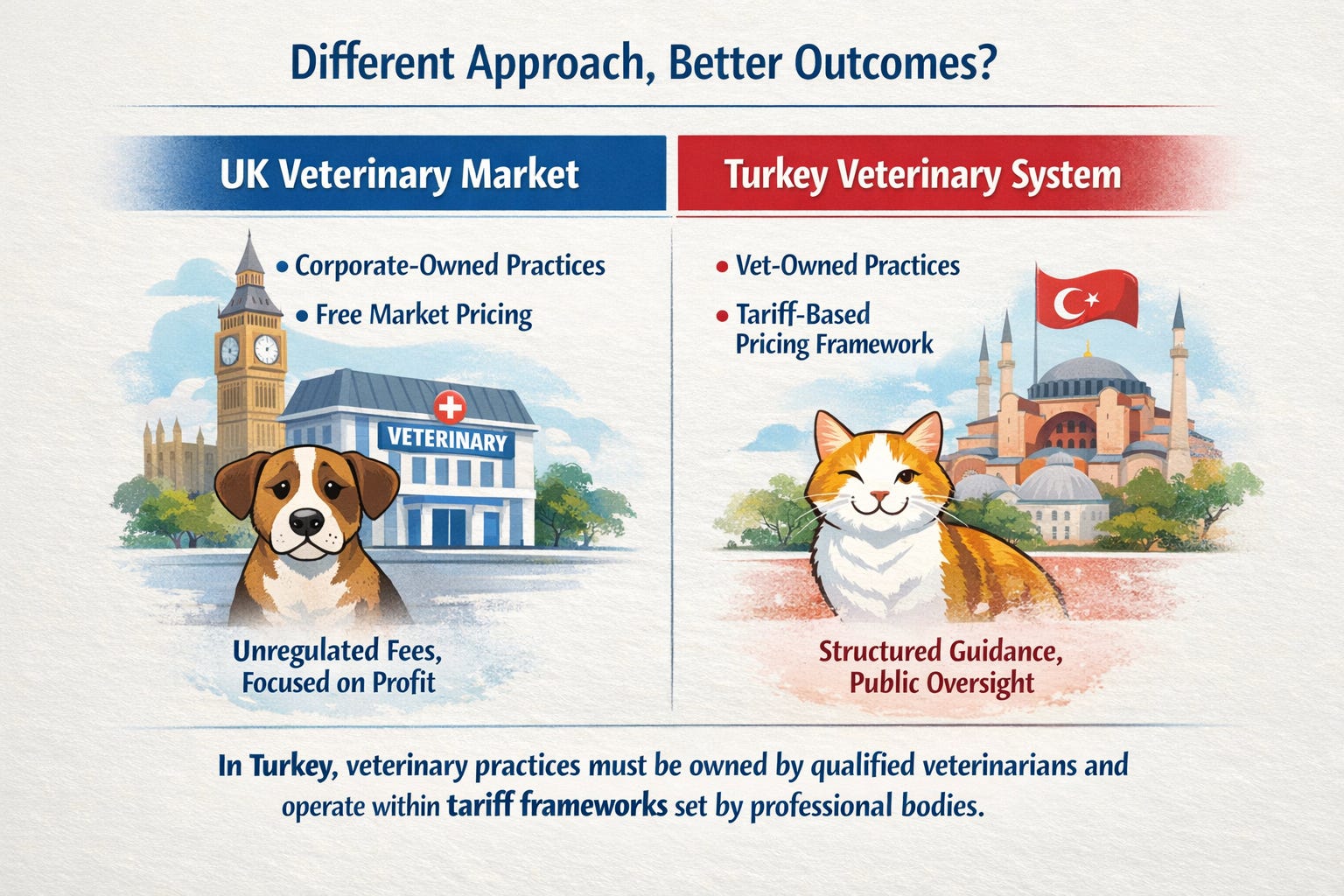
In Turkey, veterinary practices must be owned and operated by qualified veterinarians, and fees are guided by tariff frameworks set by regional chambers under the Turkish Veterinary Medical Association. These are not fixed prices, but they establish a structured baseline, limiting how low fees can go while allowing flexibility based on case complexity.
This creates a fundamentally different model to the UK.
A vet-led, tariff-guided structure versus a corporate-driven market where transparency has had to be enforced.
Bella’s case is not unusual. It is simply visible. The question now is whether transparency will lead to better decision-making or whether it will simply make the cost of uncertainty easier to see.
Because when clarity is missing, it is not just money that is lost. It is trust.