

Why Do Cats From Different Regions Look Different?
A simple observation that raises a bigger question

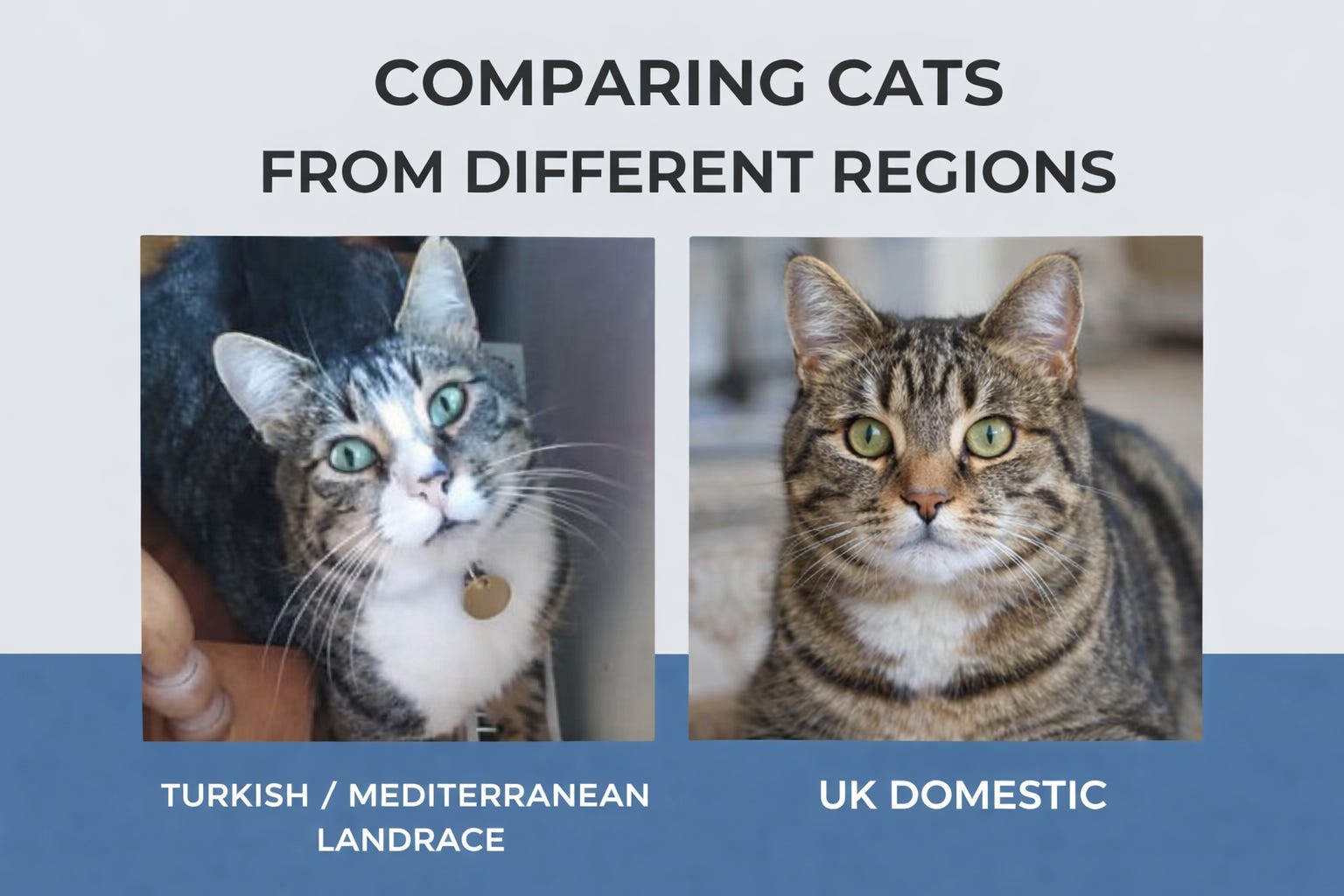
It is something many people notice, often without quite knowing why.
A cat from Istanbul may look noticeably different to a cat from the UK.
The differences are subtle at first, but once seen, they become difficult to ignore:
Eyes that are more almond-shaped than round
Ears that are larger, higher, and more pointed
Faces that are narrower, more angular
Bodies that appear leaner, more athletic
These are not isolated traits. They appear again and again across free-living cat populations in parts of Turkey and the wider Mediterranean.
So what explains this?
Landrace populations: cats shaped by environment
Most cats in Turkey are not pedigree animals. They are what is known as a landrace population, animals that have developed naturally over time without controlled breeding.
In these populations:
Reproduction is largely unrestricted
Survival influences which traits persist
The environment plays a continuous role in shaping form
Over generations, this produces a recognisable type, even though it is not a formal breed.
This is why cats in Istanbul often share a similar look, despite not being related in any structured way.
The role of climate and function
Physical traits are rarely arbitrary. In warmer climates, certain features offer practical advantages:
Larger ears assist with heat regulation
Leaner bodies are more efficient in hot environments
Shorter, sleeker coats reduce overheating
Angular facial structure reflects a lower tendency toward fat storage
These are not aesthetic choices. They are functional outcomes.
When similar environmental pressures exist across regions for example, coastal Turkey and the Greek islands similar physical traits emerge.
Why Aegean and Istanbul cats can look alike
The Aegean cat is often described as a distinct type, but it is important to understand what that means.
It is not a tightly controlled pedigree. It is a regional expression of a natural population.
Cats in western Turkey and cats on the Greek islands:
Share geography
Share climate
Share centuries of movement via trade and migration
As a result, they also share genetic continuity.
When an Istanbul cat resembles an Aegean cat, it is not imitation.
It is simply the same underlying population expressed in different locations
A comparison with UK domestic cats
In the UK, even mixed-breed cats have often been influenced, directly or indirectly, by selective breeding over time.
This influence tends to produce:
Rounder eyes
Smaller ears
Broader faces
Heavier, more compact bodies
These traits reflect human preference rather than environmental necessity. The contrast is not absolute, but it is consistent enough to be noticeable.
Tigger as a case example
Tigger, an Istanbul cat who lives with me & seen in the graphic here, illustrates this clearly.
His features include:
Distinct almond-shaped eyes
Large, upright ears
A balanced, angular face
A lean, proportionate build
He is not unusual within his environment. He is representative of it.
If placed on a Greek island, he would likely be described as Aegean-type. In Istanbul, he is simply a typical street-born cat.
What this tells us about cats more broadly
The differences we see between cats in different regions are not primarily about breed.
They are about:
Environment
Population history
Human influence or the absence of it
In regions where cats have been allowed to develop naturally, their appearance reflects function, adaptation, and continuity with their origins. In regions shaped more heavily by human preference, appearance shifts accordingly.
Closing reflection
There is a tendency to categorise animals into named breeds and types. But many of the world’s cats do not fit neatly into those categories.
They are not designed. They are not standardised. They are simply the result of generations of life lived in a particular place.
Cats from different regions do not just look different by chance.
They reflect the environments, histories, and conditions that shaped them.