


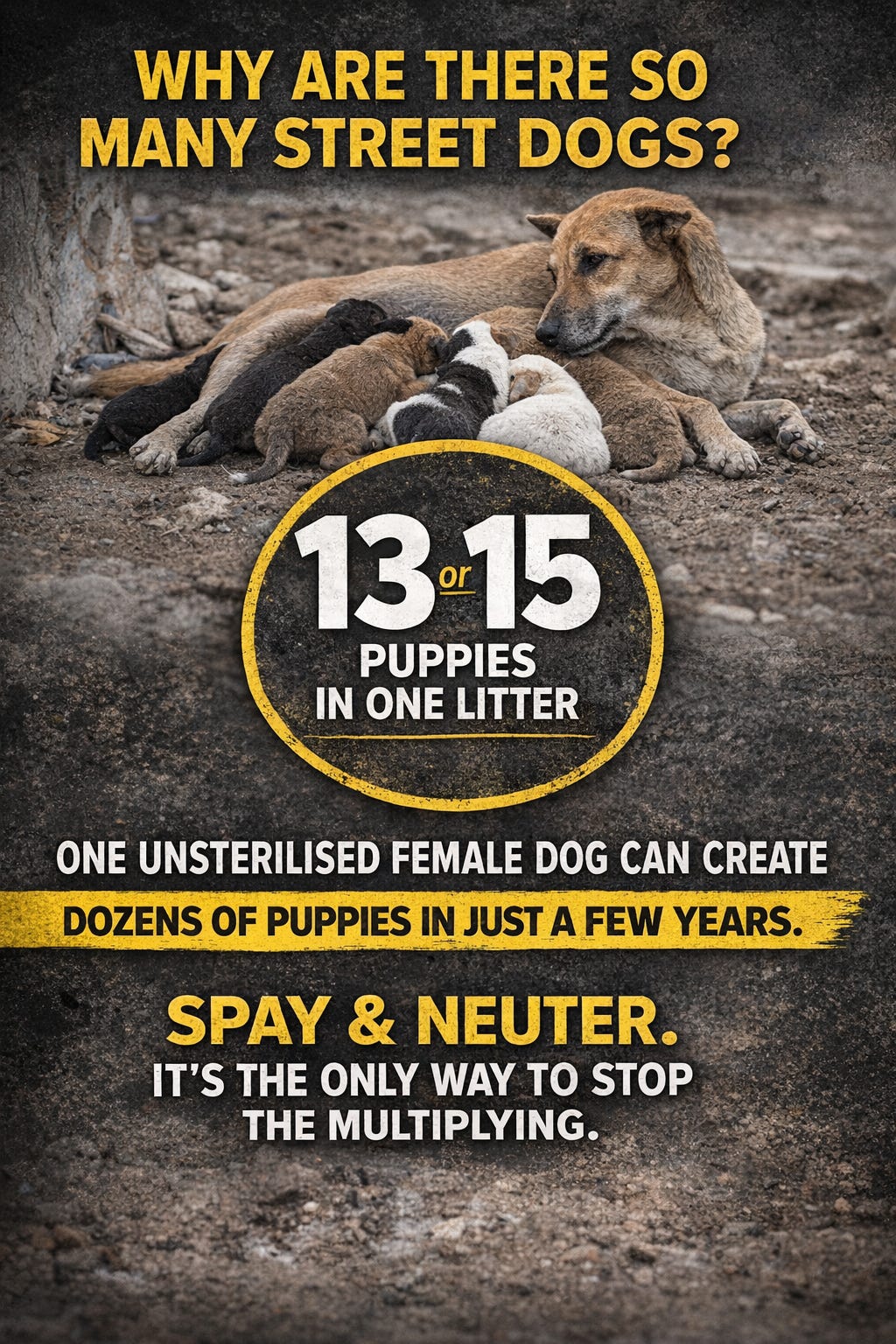
Very recently we came in contact with two pregnant strays who gave birth to 13 & 15 puppies
For many people, those numbers feel extraordinary. They are not.
They are, in fact, a clear illustration of how quickly and efficiently the stray dog population can grow when reproduction is left unmanaged.
Litter Size Is Not the Exception It Is the Mechanism
In domestic settings, people are often familiar with smaller litters. Five or six puppies might be considered typical. In free-breeding dog populations, particularly among street dogs, that assumption does not hold.
Litter sizes of:
8–10 are common
10–12 are frequent
12–15 are entirely possible
These are not anomalies. They are part of the biological design. Dogs are a species that reproduces in numbers. Where there is no intervention, that capacity is fully expressed.
Street Dogs Are Not Poorer Versions of Owned Dogs
Street dogs are often misunderstood as neglected or biologically compromised versions of pet dogs. In reality, many are mixed-type dogs whose genetics have not been shaped by selective breeding for human preference.
This matters. Unlike some pedigree dogs, which may have:
Reduced fertility
Smaller litter sizes
Increased reproductive complications
Street dogs often retain:
High fertility
Efficient reproduction
The ability to sustain larger litters
From an evolutionary perspective, producing more offspring increases the likelihood that some will survive in unpredictable environments.
When Conditions Are Stable, Litter Sizes Increase
It is important to understand that large litters are not only a product of biology, but also of circumstance. Where dogs have:
Access to regular feeding (even informally, by communities)
Reasonable physical condition
Low immediate disease burden
Their bodies are capable of sustaining larger pregnancies. This creates a paradox.
The very communities that show compassion by feeding dogs may unintentionally contribute to higher birth rates if sterilisation is not in place.
Uncontrolled Breeding Is Exponential, Not Linear
A single female dog does not produce a few puppies. She produces litters.
And those puppies, if left unsterilised, go on to reproduce themselves.
When litters reach sizes of 10, 12, or 15:
Population growth accelerates rapidly
The number of dogs increases in cycles, not increments
Local capacity to cope is quickly overwhelmed
This is why areas can appear stable for a period, and then suddenly experience a visible surge in dog numbers. It is not sudden. It is cumulative.
Why This Matters for Policy and Public Understanding
Discussions about stray dogs are often framed around visible outcomes:
Dogs on the streets
Dogs in shelters
Complaints, incidents, and conflict
What is less often acknowledged is the underlying driver. Reproduction. Without structured, sustained sterilisation programmes:
The number of dogs will continue to rise
Shelters will continue to fill
Reactive measures will continue to fail
Large litters are not the problem in themselves. They are evidence of a system without control.
The Only Effective Response
There is no short-term solution to a long-term biological process.
Removing dogs does not stop reproduction. Relocating dogs does not stop reproduction. Culling dogs does not stop reproduction. Only sterilisation interrupts the cycle. Not sporadically. Not symbolically. But at scale, and sustained over time.
A Simple Reality
When a single dog can give birth to fifteen puppies, the question is not why are there so many pups
The question is why are we still allowing them to reproduce unchecked