
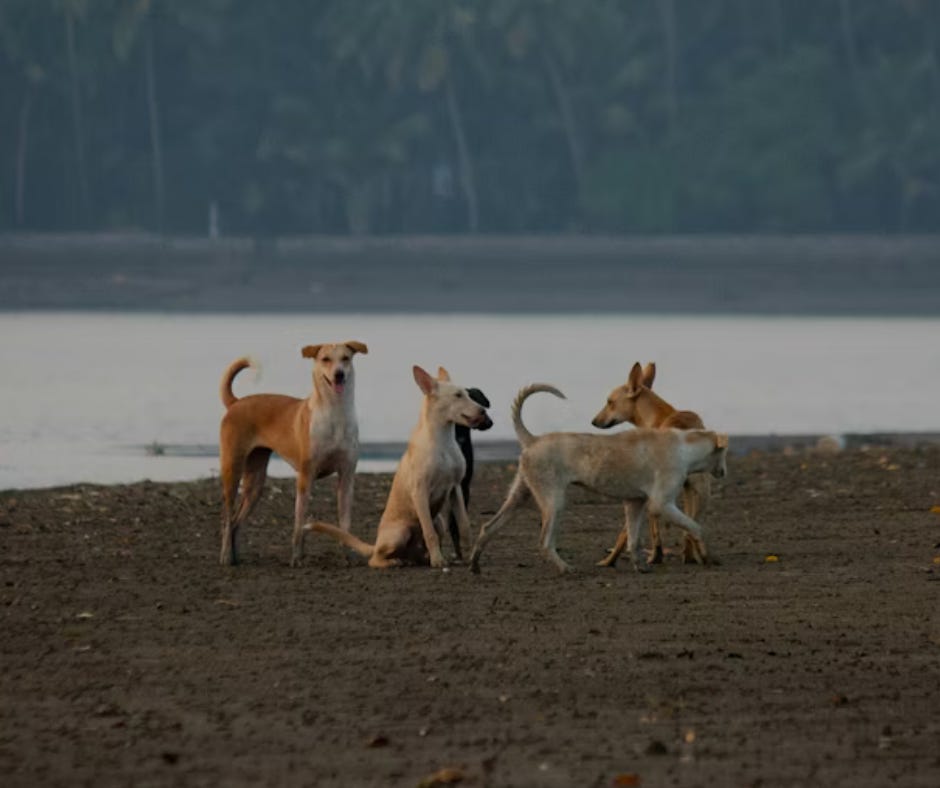
Why Do Street Dogs Form Packs?
Walk through almost any city where free-roaming dogs live and you’ll see it: not just one dog, but several. Moving together. Resting together. Watching together.
It’s easy to assume the worst, that packs are aggressive, dangerous, or organised with intent.
But the reality is far more ordinary.
Street dogs form packs because it helps them survive.
Dogs Are Social by Nature
Domestic dogs are descendants of the grey wolf. While street dogs are not wolves, they retain a deeply social instinct. Cooperation is wired into them.
Living alongside others provides:
Shared vigilance against threats
Protection for vulnerable members
Social bonding and reduced stress
Better access to resources
Isolation, in the wild or on the street, is rarely an advantage.
Survival Is Easier Together
Life on the street is unpredictable.
Food appears and disappears. Humans may be kind or hostile. Vehicles, weather, and territorial disputes create constant risk.
In small, loose groups, dogs:
Alert one another to danger
Share access to feeding spots
Learn from more experienced dogs
Defend themselves more effectively
This is not a militarised structure. It is cooperation born of necessity.
Packs Are Usually Fluid, Not Fixed
Unlike the rigid hierarchy often portrayed in documentaries, street dog packs are usually flexible.
Membership changes. Dogs drift in and out. Females with puppies may stay close to trusted companions. Young males may move between groups.
Most free-roaming dogs are far less interested in domination than in stability.
Why Packs Sometimes Appear Threatening
When humans feel uneasy around multiple dogs, fear can escalate quickly. But behaviour that looks intimidating is often:
Territorial barking
Alert responses to strangers
Defensive posturing
Protective behaviour around food or puppies
Context matters. A group of dogs reacting to a perceived threat is not the same as a group actively seeking conflict.
Studies of free-roaming dog populations show that most aggression toward humans is reactive, not proactive.
Urban Ecology Plays a Role
Street dogs don’t exist outside the ecosystem they are part of it.
Unmanaged waste, inconsistent feeding, lack of sterilisation, and displacement policies all shape how dogs organise themselves.
Where humane sterilisation and vaccination programmes operate consistently, pack tensions decrease, populations stabilise, and conflict reduces.
It is not packs that create instability.
It is instability that creates stressed packs.
The Bigger Picture
Street dogs form packs for the same reason humans build communities:
Safety. Familiarity. Shared survival.
In places where municipal systems struggle, where resources are stretched, and where fear can outpace fact, these groups are often misinterpreted.
But look closely and you’ll see something else:
Dogs leaning into one another for warmth.
Older dogs guiding younger ones.
Mothers protected by familiar companions.
Not menace.
Mechanism.
Understanding behaviour is the first step toward humane policy and away from reactionary narratives that do little to solve the real issues.
Because when survival is uncertain, no one thrives alone.


