

Why Does Identical Animal Welfare Content Get Treated Differently on X?
Why small animal welfare accounts are being quietly limited while larger account content spreads without friction.

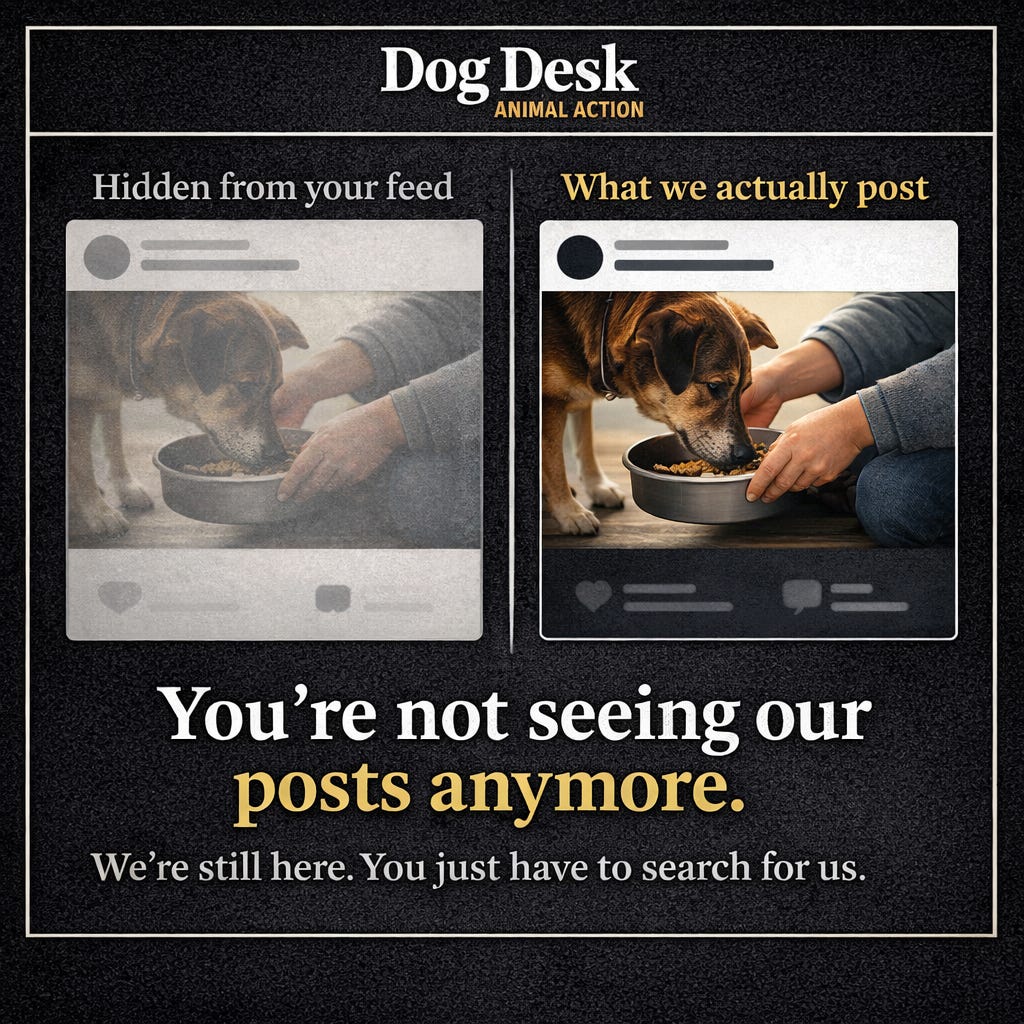
There is a pattern emerging across animal welfare accounts on X that is difficult to ignore.
Larger accounts are able to post without the same level of scrutiny, while smaller, on-the-ground organisations are limited in how far their content travels.
Who gets seen is shaping the narrative.
This is not speculation. It is observable.
Observed Behaviour
Over the past month, our own account has experienced:
Repeated search suggestion bans
Cyclical restriction patterns (on/off over multiple weeks)
Significant reduction in distribution despite consistent posting
Strong engagement ratios when content is seen, but limited reach
The content posted during this period includes:
Dogs resting or interacting normally
Day-to-day care routines
Non-graphic footage of feeding, cleaning, and enrichment
Standard community posts (good morning, goodnight, updates)
There is no graphic content. No distress imagery. No policy violations.
Yet visibility remains limited.
Comparison With Larger Accounts
Other animal-related accounts, including those posting:
Injured animals
Emergency rescues
Distressing footage
continue to receive:
High levels of distribution
Strong engagement at scale
Platform tolerance, sometimes but not always with warnings rather than suppression
This creates a clear inconsistency:
Content that is objectively more distressing is distributed widely.
Yet identical content is not treated equally, larger accounts are able to distribute it without consequence, while smaller accounts posting the same material are limited.
The Likely Mechanism
The most plausible explanation is not individual post moderation, but account-level classification combined with engagement-based distribution.
Accounts appear to be sorted into broad categories such as:
“High-engagement / expected sensitive content” - tolerated
“Lower-engagement / potentially sensitive content” - restricted
Once classified, content is not evaluated equally.
Instead:
High-engagement accounts are allowed to distribute widely, even when content is flagged
Lower-engagement accounts are restricted, regardless of whether individual posts are benign
This creates a feedback loop:
Restricted accounts receive less reach
Lower reach produces lower total engagement
Lower engagement reinforces restriction
Meanwhile:
Large accounts continue to scale, reinforcing their “trusted” status
Accuracy, Proximity, and Misinformation
There is a further concern within this dynamic.
Accounts with large followings are often treated as high-confidence sources, regardless of their proximity to the situations they report on.
In practice, this can result in:
Incomplete or incorrect information being widely distributed
Local context being lost or misunderstood
Narratives forming that do not accurately reflect conditions on the ground
We see this regularly.
Content relating to regions we work in is frequently shared at scale by accounts with no direct operational presence. In many cases, clarification is required after the fact to correct or add context to their posts.
However, those corrections never travel as far as the original post.
Visibility without proximity risks amplifying narratives that are incomplete at best, and misleading at worst.
The Erosion of Smaller Voices
There is a growing imbalance that should concern anyone involved in animal welfare.
Smaller organisations, those doing consistent, day-to-day work on the ground are increasingly struggling to be seen. Their reach is reduced, their visibility limited, and their ability to communicate is quietly constrained.
At the same time, larger accounts, often operating at distance from the realities they report on or in some cases not operating in the realities at all, are prioritised and amplified.
In some cases, these accounts are not only shaping the narrative, but doing so with incomplete or inaccurate information.
This creates a deeply uneven landscape:
Those closest to the work are least visible
Those with the largest platforms are treated as authoritative
Corrections and context rarely travel as far as the original claims
Within a community that is built on care, responsibility, and trust, this should give pause. Because visibility is not neutral.
When systems prioritise scale over accuracy, and amplification over proximity, they do more than shape content they shape understanding.
And when smaller, more knowledgeable voices are consistently limited, the risk is not just reduced reach.
It is the gradual erosion of informed, responsible discourse in animal welfare.
A system that elevates reach over accuracy does not strengthen a caring community, it weakens it.
Why This Matters
This is not simply a question of platform performance.
It affects:
Visibility of responsible animal care
Public understanding of welfare work
The ability of smaller organisations to reach supporters
When calm, factual, non-dramatic content is limited, and emotionally intense content is amplified through large accounts, the public narrative becomes distorted.
Operational Impact
The result for organisations like ours is a forced choice:
Continue posting accurately and accept limited reach or further restrictions.
Alter content to fit platform expectations
Or shift focus to platforms where distribution is not constrained in the same way
Position
We will not alter our work to fit a system that fails to interpret it correctly.
We will continue to:
document real conditions
show daily care
present animals as they are
But we will have to prioritise platforms where this work can be seen. Seen by a smaller audience but at least it will be visible.
This is not simply a question of platform behaviour.
It is a question of what kind of information is allowed to shape public understanding of animal welfare.
When visibility is uneven, accuracy is compromised. When those closest to the work are limited, and those further removed are amplified, the result is not just imbalance, it is distortion.
The work itself has not changed. But who is able to show it and how far it travels clearly has.
And that ultimately effects the animals.