
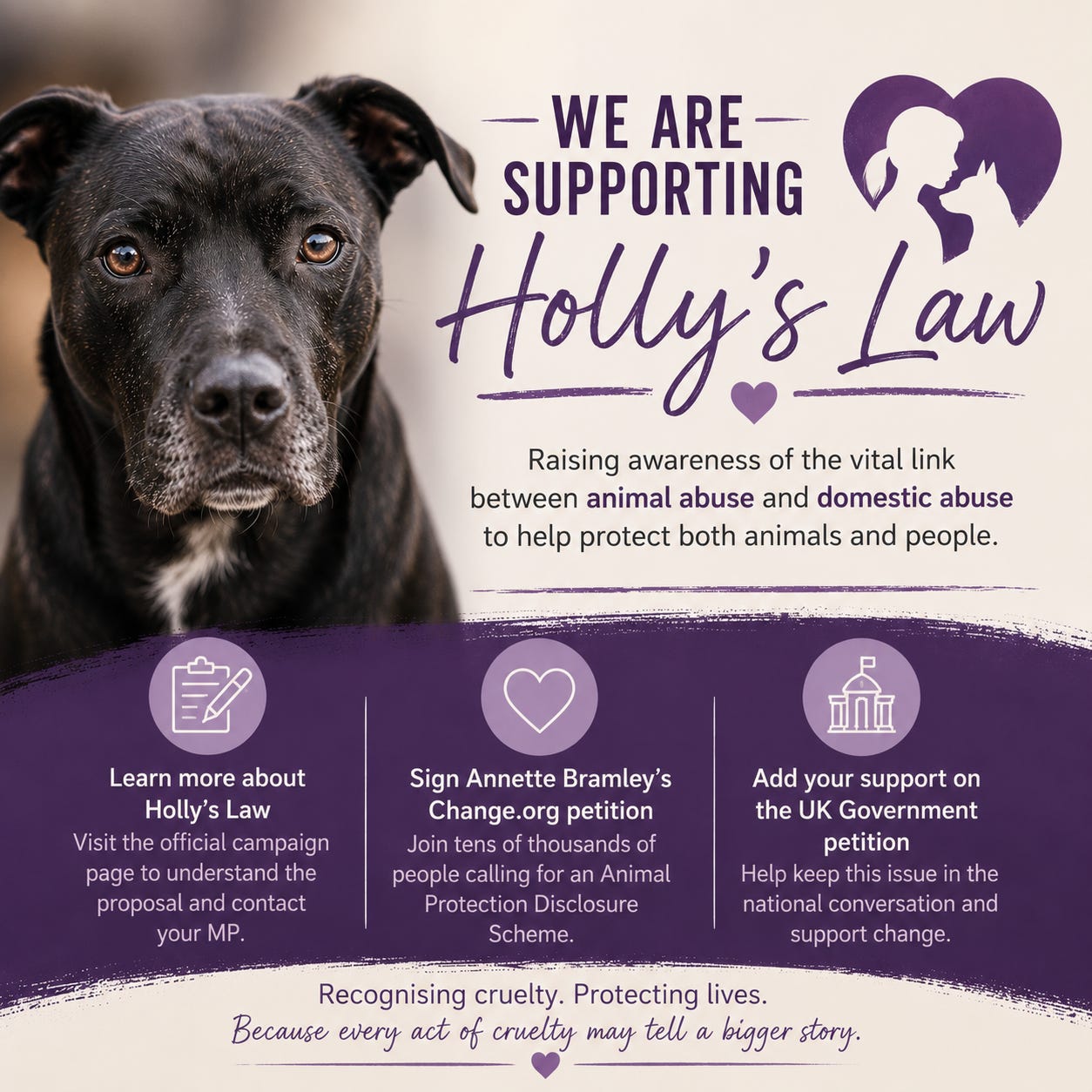
Every now and then we come across a campaign that feels as though it has been part of our journey long before we ever knew its name.
This week we had the privilege of meeting with the team behind Holly’s Law. It was one of those conversations where the connection was obvious from the very beginning. We spoke about animals, about violence, about safeguarding and about the responsibility we all have to recognise the warning signs that are too often overlooked. By the end of the meeting we had made our decision. Dog Desk Animal Action will be supporting Holly’s Law by helping to raise awareness of the campaign and the important issues it represents.
For some people, that might seem like an unexpected direction for us.
After all, much of our work focuses on free roaming dogs, international animal welfare policy and the challenges faced by communities trying to protect the animals in their care. We spend our days analysing legislation, following developments around the world and speaking up for dogs that too often have no voice of their own.
Yet, in reality, supporting Holly’s Law could not be more closely aligned with everything we believe.
For a long time we have understood that violence against animals does not always exist in isolation. Those of us who work in animal welfare see the consequences of cruelty every day, but we have also come to recognise that cruelty can sometimes be part of a much wider pattern of abuse. Research has repeatedly highlighted the relationship between animal abuse, coercive control and domestic abuse. That does not mean every person who harms an animal will go on to harm another human being, but it does mean that deliberate cruelty should never be dismissed as something that affects only the animal.
Our own experiences have reinforced that understanding.
Much of our work takes place in Türkiye, where we have witnessed extraordinary compassion towards animals, but also some of the darkest examples of cruelty. It is also a country that continues to face serious challenges in tackling violence against women. Working in that environment changes the way you think. You begin to see that violence rarely fits neatly into separate categories. It often reaches every vulnerable member of a household, whether they have two legs or four.
That is why Holly’s story resonated so deeply with us.
Holly Bramley loved animals. According to her family, during an abusive relationship the animals she cared about were repeatedly harmed and killed as part of a pattern of coercion and control before Holly herself was murdered in 2023. Faced with unimaginable loss, her mother, Annette Bramley, chose to transform grief into determination, launching Holly’s Law to encourage greater recognition of the link between animal abuse and domestic abuse, including the introduction of an animal abuse register and stronger safeguards to help identify patterns of offending.
It is a campaign that asks society to look beyond the immediate act of cruelty and to ask a more difficult question. What else might be happening?
That question has already reached Westminster. During a parliamentary debate on Holly’s Law, MPs from across the political spectrum spoke about the importance of recognising the connection between animal abuse and domestic abuse, with veterinary surgeon and MP Dr Danny Chambers describing animal abuse as something that can be “the first symptom of something much more dangerous.” Whether discussing safeguarding, coercive control or information sharing between agencies, the debate reflected a growing understanding that protecting animals and protecting people are often closely connected.
We believe that conversation deserves to continue.
Holly's Law asks society to look at animal cruelty differently. It challenges the assumption that deliberate abuse is simply an offence against an animal and instead asks whether it may also be a warning sign that someone else is living with fear, coercion or violence. Those are difficult questions, but they are questions worth asking. They deserve the attention of animal welfare organisations, veterinary professionals, safeguarding agencies, the police, policymakers and anyone committed to protecting the most vulnerable members of our communities.
Animal welfare has never been just about treating injuries, feeding hungry dogs or building shelters. It has always been about creating a society that rejects cruelty in all its forms and recognises that compassion is not something we divide between animals and people. It is something we extend to both.
We are proud to be supporting Holly’s Law, and over the coming months we will do everything we can to help ensure this important conversation reaches as many people as possible.
Because recognising violence for what it is may be one of the most important ways we can protect both animals and the people who love them.
If Holly’s Law has resonated with you as it has with us, we encourage you to learn more about the campaign and lend it your support.
The official Holly’s Law campaign, led by Annette Bramley and Catherine Haworth of Haworth Family Law, explains the proposed Animal Protection Disclosure Scheme, why it is needed and how you can contact your MP using a ready made template letter.
Learn more here:
https://www.haworthfamilylaw.co.uk/hollyslaw
Annette Bramley has also launched a public petition calling for the establishment of Holly’s Law. At the time of writing, it has been signed by more than 61,000 people who believe the link between animal abuse and domestic abuse deserves greater recognition and stronger safeguarding measures.
You can add your name to the petition here:
There is also a petition launched by Bea Elton
UK Parliament and Government petition:
https://petition.parliament.uk/petitions/759783
This is a conversation that reaches far beyond animal welfare. It is about recognising patterns of violence, protecting the vulnerable and ensuring that warning signs are never ignored. We are proud to support Holly’s Law and look forward to helping more people understand why this campaign matters.


