

Why Has Türkiye’s Stray Dog Numbers Suddenly Shrunk From 4 Million To 1 Million on Paper

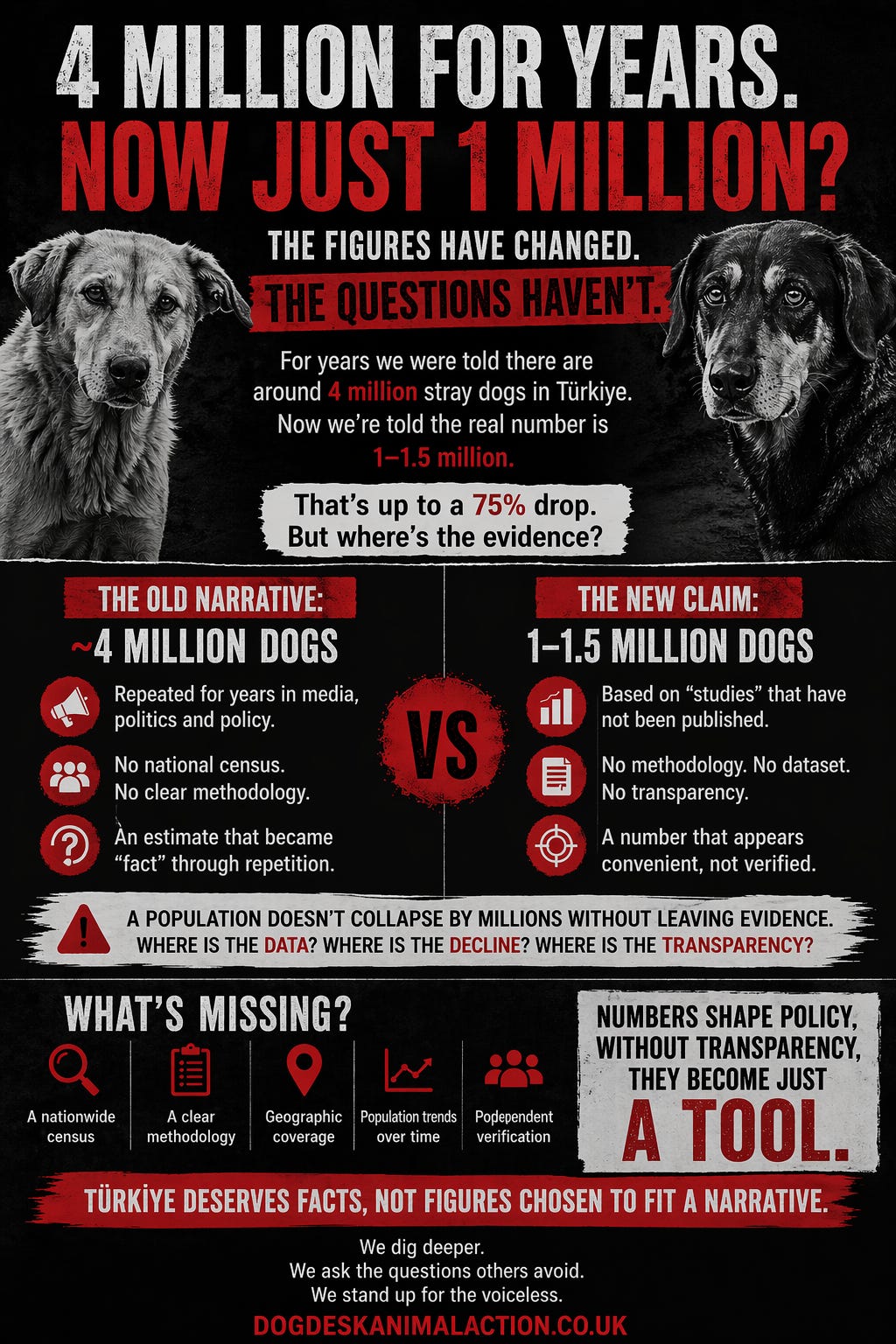
For years, one figure dominated public discussion in Türkiye:
Around 4 million stray dogs.
It appeared in media reporting, political statements, and policy debates. It shaped public perception and helped frame the issue as urgent, large-scale, and increasingly unmanageable.
Now, a very different claim has emerged from Ahmet Yavuz Karaca:
The real number is closer to 1–1.5 million. That is not a minor correction. It is a reduction of up to 75%.
And it raises a question that cannot be ignored:
What changed?
The Scale of the Shift
A population does not collapse by millions without leaving evidence.
If Türkiye’s stray dog population had genuinely dropped from around 4 million to 1–1.5 million, we would expect to see:
Large-scale, sustained sterilisation at high coverage
Clear declines recorded across municipalities
Transparent national datasets tracking the reduction
None of this has been publicly presented.
There has been no published, verifiable dataset showing a population collapse of that scale.
The More Likely Explanation
When a number changes this dramatically, there are only a few realistic explanations:
1) The original figure was never robust
The 4 million estimate was widely repeated, but:
It was not backed by a national census
It lacked clear methodology
It was often presented without source transparency
In simple terms, it was an estimate that became accepted through repetition.
2) The new figure is based on a different method but not disclosed
Karaca refers to studies producing more realistic data.
But without:
Methodology
Sampling framework
Geographic coverage
Margin of error
the new estimate cannot be independently assessed.
3) The narrative has shifted
Population figures do not exist in isolation. They shape and are shaped by policy.
A higher number supports urgency and large-scale intervention
A lower number suggests the issue is more contained, more manageable
Both can be used to justify different approaches.
Without transparency, the risk is that the number becomes a policy tool rather than a measured reality.
Evidence of Reduction
If the population has truly decreased, there should be supporting indicators:
Increased sterilisation coverage approaching 70%
Reduced intake pressure across shelters
Fewer births observed in known dog populations
Instead, available information points to:
Low sterilisation coverage
Continued pressure on municipal systems
Ongoing reports of uncontrolled reproduction
These conditions are not consistent with a population that has dropped by millions.
Why This Matters
This is not just about numbers. It is about credibility and decision-making.
When figures shift dramatically without explanation:
Public trust is weakened
Policy justification becomes unclear
Effective solutions are harder to implement
Because if the scale of the problem is uncertain, the response will be too.
The Question That Needs Answering
If the number was truly 4 million for years:
On what basis was that figure used?
Why was it accepted without transparent data?
And if the number is now 1–1.5 million:
What methodology produced it?
Where is the dataset?
Why has it not been published for scrutiny?
The Reality
Two conflicting figures now exist:
A long-standing estimate of around 4 million
A new claim of 1–1.5 million
Neither has been supported with a fully transparent, independently verifiable national dataset.
The Conclusion
This is not simply a correction. It is a fundamental inconsistency. And until Türkiye provides:
Clear methodology
Full population data
Independent verification
the issue is not whether the number is 4 million or 1 million. It is that the system producing these numbers remains opaque.
Because when figures can shift this dramatically without explanation,
the problem is no longer just the dogs.
It is the data itself.