
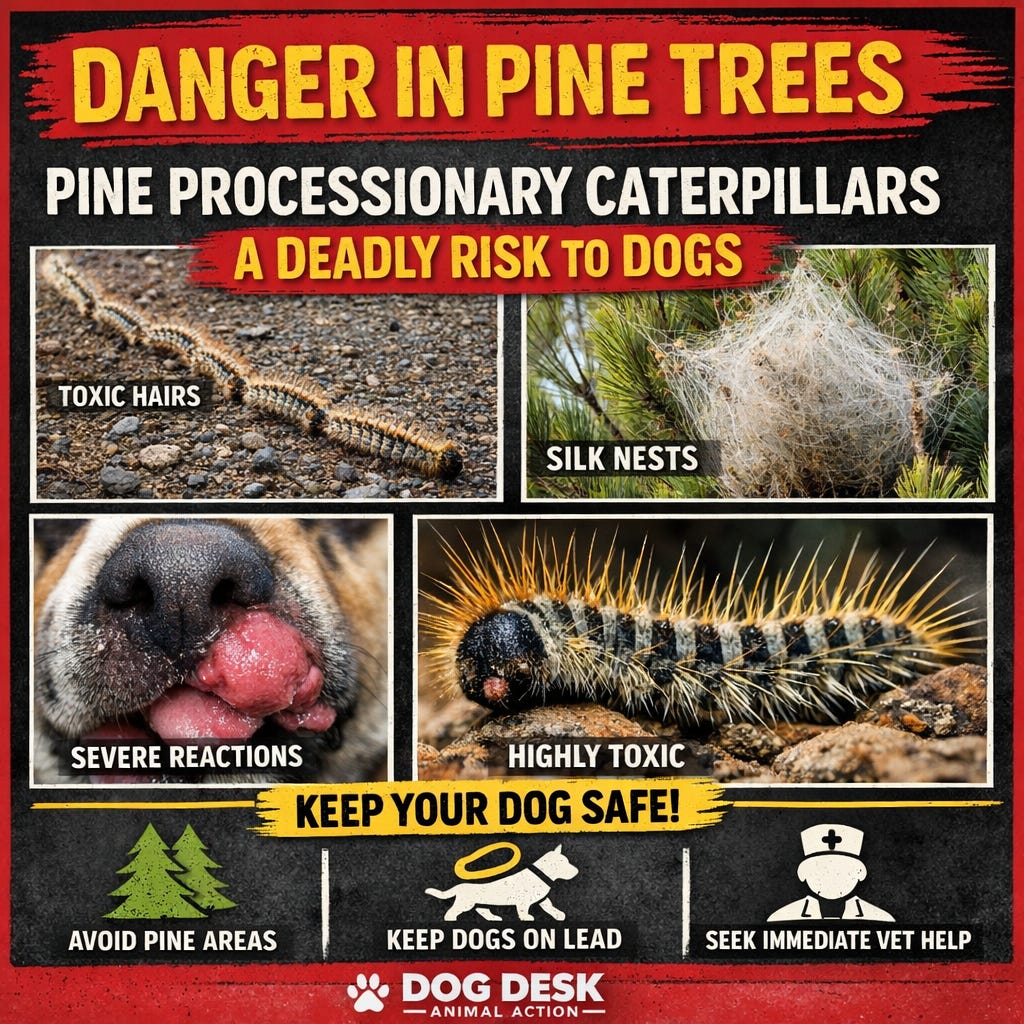
Most dog owners don’t know what a pine processionary caterpillar looks like. That’s the problem. Because by the time they do, it’s often already an emergency.
These caterpillars don’t bite. They don’t chase. They don’t behave like a threat. They simply move across the ground in slow, nose-to-tail lines beneath pine trees, exactly the kind of thing a dog will stop to investigate.
And that single moment of curiosity can be enough.
Within minutes of contact, dogs can develop severe reactions. Swelling of the tongue, intense pain, distress. In some cases, the tissue begins to die. Without rapid treatment, the consequences can be permanent or fatal.
This is not rare. It is not isolated. And it is spreading.
What Most People Don’t See
The pine processionary caterpillar does not look like a threat. It moves slowly.
It travels in neat, almost mesmerising lines. It appears, at first glance, to be part of the natural background of a walk.
But this is one of the most dangerous seasonal hazards a dog can encounter outdoors.
High in pine trees, these caterpillars build white silk nests often mistaken for harmless debris. When temperatures shift in late winter and early spring, they descend to the ground and begin their processions.
That is the moment risk meets curiosity.
The Mechanism of Harm
This is not about bites or stings. Each caterpillar is covered in thousands of microscopic, barbed hairs containing a toxin known as thaumetopoein.
These hairs are designed to detach. They embed into skin. They lodge in the mouth.
They can even become airborne and inhaled.
A dog does not need to eat a caterpillar to be affected. A single investigative sniff can be enough.
What Happens Next
The reaction is often immediate and severe.
Owners describe a sudden shift from a normal walk to visible distress within minutes.
Intense drooling
Swelling of the tongue and lips
Pawing at the mouth
Vomiting
Disorientation
In the most serious cases, the toxin causes tissue death. Parts of the tongue can become necrotic. Some dogs lose sections of it permanently. Without rapid veterinary care, the situation can escalate quickly.
This is not a scenario where observation is appropriate. It is an emergency.
A Changing Geography
Historically, this was seen as a problem confined to southern Europe. That is no longer the case.
Warmer winters have allowed populations to expand northwards. Regions that previously had little or no exposure are now encountering them with increasing frequency.
The issue is not just presence. It is awareness. Because where awareness is low, risk is higher.
The Behavioural Mismatch
Dogs investigate the world through contact. They smell. They touch. They taste.
Everything about the pine processionary caterpillar exploits those instincts.
It moves at ground level, often across paths. It travels in lines that attract attention.
It appears non-threatening. From a dog’s perspective, it is exactly the kind of thing worth investigating.
And that is the problem.
Prevention Is the Only Real Protection
There is no safe interaction. There is no tolerance threshold. Avoidance is the only reliable safeguard.
Be cautious in pine-heavy areas, particularly late winter to early spring
Keep dogs on lead where processionary caterpillars are known to exist
Learn to recognise the white silk nests in trees
Never allow investigation of moving lines on the ground
Even dead caterpillars remain dangerous. Their hairs retain their toxic properties.
What To Do If It Happens
Speed matters. If contact is suspected:
Prevent further contact (no licking or rubbing)
Avoid handling the area directly
Rinse gently with water if possible (without rubbing)
Seek immediate veterinary care
Delays can significantly worsen outcomes.
Why This Matters Now
This is not a rare, isolated hazard. It is a predictable, seasonal risk that is spreading geographically. And like many risks of this kind, it sits in the gap between knowledge and assumption.
Most people simply do not know it exists.
Final Reflection
We often talk about protecting dogs from obvious harm. But some of the most serious threats are the ones that do not look like threats at all.
A quiet path. A line of caterpillars. A moment of curiosity. That is all it takes.
Awareness is not optional here. It is the difference between a normal walk and a life-altering emergency.


