

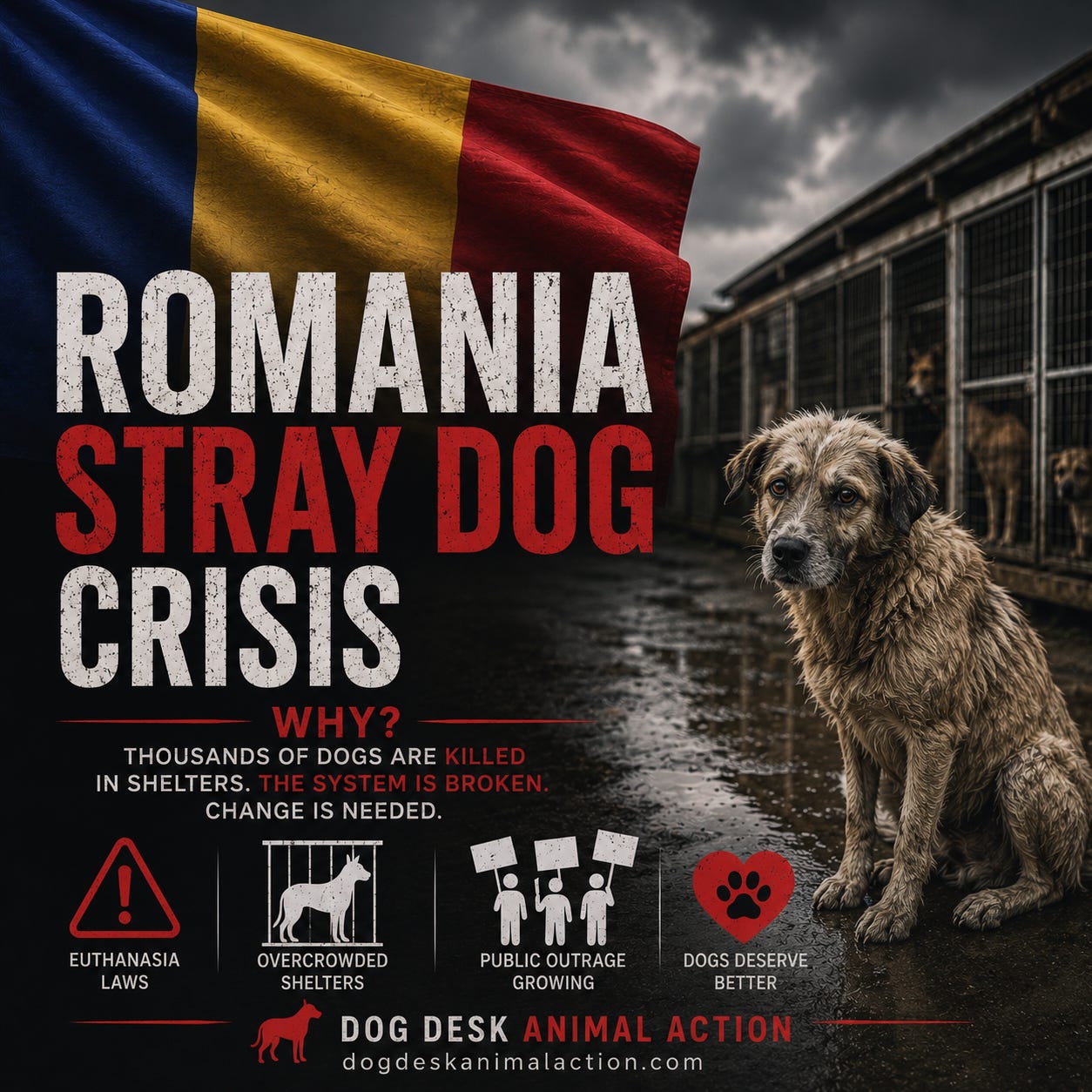
Romania’s stray dog debate is once again intensifying, with growing protests, renewed scrutiny of shelters, and increasing public anger over how dog populations are being managed.
For years, the country has struggled with one of Europe’s largest free-roaming dog populations. The issue has repeatedly moved between public safety concerns, euthanasia policies, sterilisation campaigns, and allegations of corruption linked to municipal dog contracts. But recent events suggest something deeper is happening.
The debate is no longer only about stray dogs on the streets. Increasingly, it is becoming a debate about trust in the systems built to manage them.
Romanian-language media and campaign groups have recently focused heavily on allegations surrounding euthanasia contracts and conditions inside parts of the shelter system. Public protests intensified following reports connected to the Suraia shelter, where activists claimed extremely high death figures and demanded greater transparency around what was happening to collected dogs.
While some allegations remain disputed, the scale of the public response has been significant. Demonstrations, online campaigns, and investigative reporting have all contributed to renewed national attention on the issue.
An investigation this year described overcrowded shelters, untreated injuries, freezing conditions, and high mortality rates within parts of Romania’s public shelter network. Campaigners interviewed during the investigation argued that some systems had become financially dependent on dog collection and euthanasia rather than long-term prevention strategies such as sterilisation.
That accusation strikes at the centre of the debate.
Romania legalised euthanasia for unclaimed dogs after holding periods in 2013 following public outrage over fatal attacks linked to stray dogs. The policy was presented as a necessary response to a serious public safety issue.
More than a decade later, however, many campaigners argue that the core problem remains unresolved. Large stray populations still exist, shelters remain overcrowded, rescuers continue reporting high pressure on the ground. And public trust in authorities appears increasingly fragile.
For many welfare groups, this is why sterilisation has once again become central to the discussion. Campaigners argue that large scale killing does not stabilise populations long term if abandonment, breeding, and inadequate sterilisation continue.
At the same time, frustration appears to be growing among sections of the public who believe transparency inside some shelters is insufficient. Questions around death figures, procurement contracts, shelter oversight, and independent monitoring are now becoming part of mainstream discussion rather than remaining confined to activist circles.
Across Europe, governments and municipalities are facing growing pressure over how free-roaming dog populations are managed. Romania has become one of the clearest examples of what happens when long-term population pressures collide with political pressure, limited infrastructure, and public distrust.
Not all animal welfare crises emerge suddenly. Some develop slowly over years, inside systems that people gradually stop believing are working.
That appears to be part of what is now happening in Romania.
The country’s stray dog debate is escalating again because the public conversation has changed. The focus is no longer only on the presence of dogs on the streets, but on whether the structures created to deal with them are humane, transparent, and capable of solving the problem at all.