


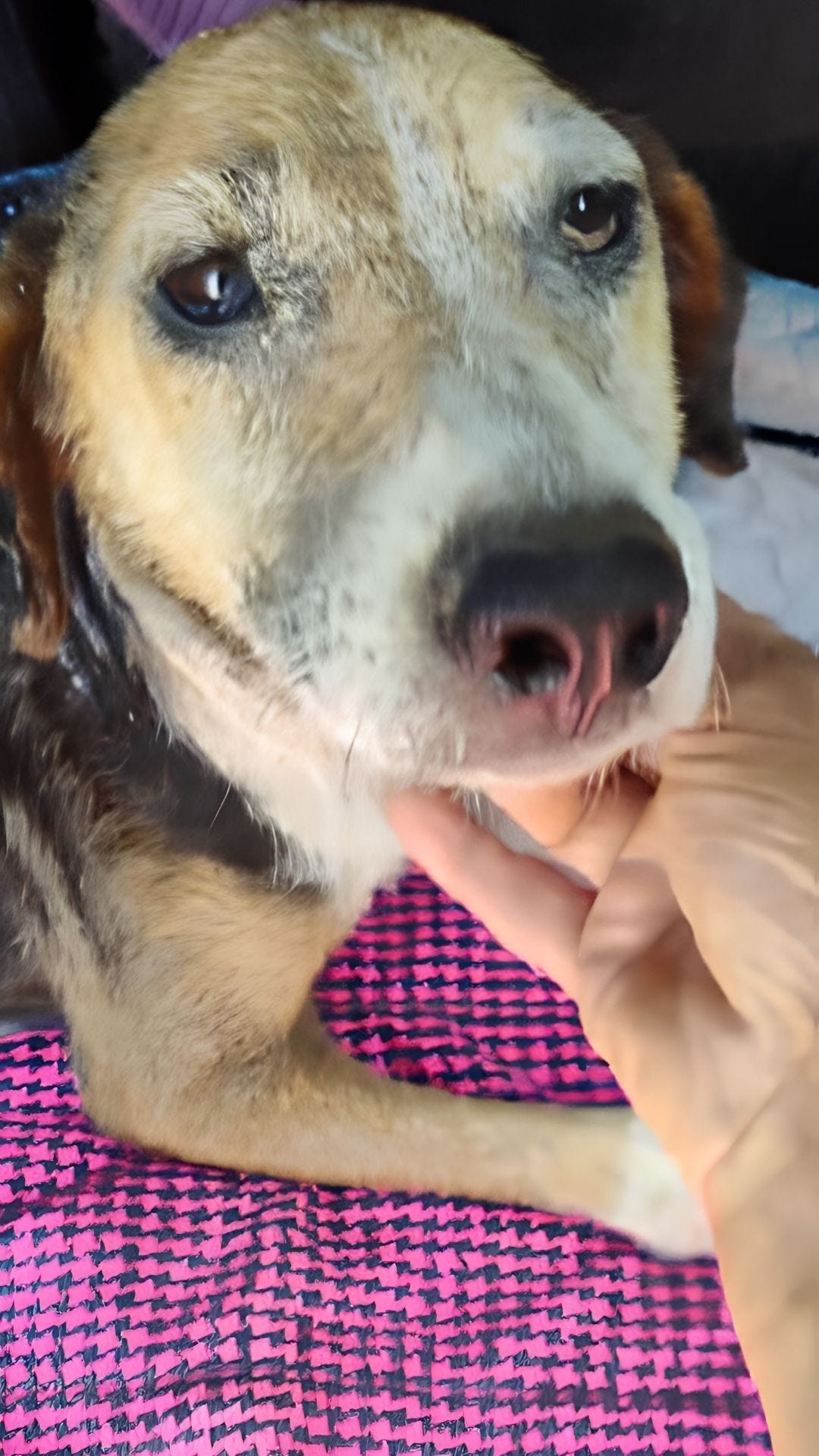
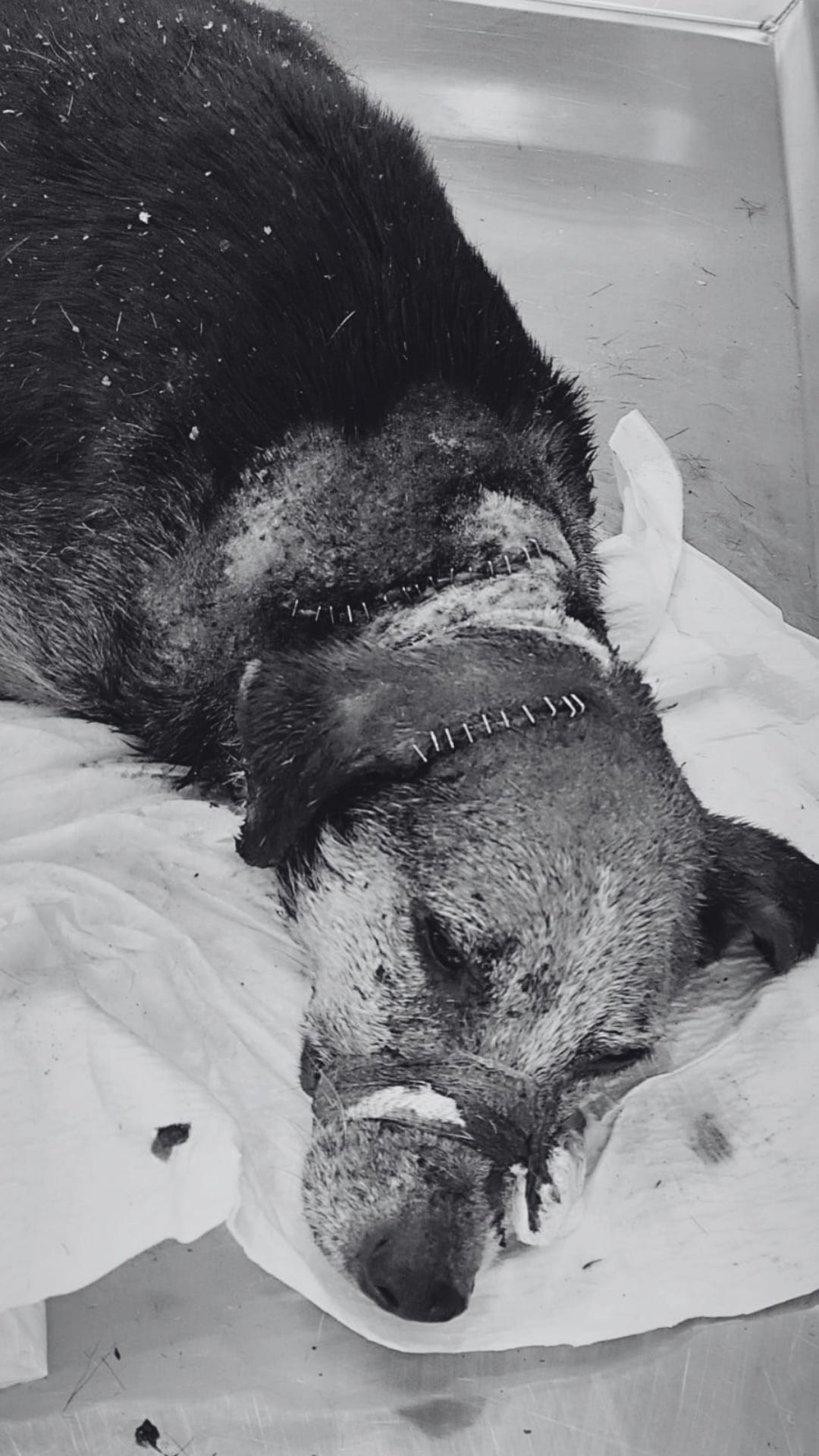
When Izzy first arrived nobody knew whether she would survive. She had once been somebody’s dog and, while we cannot say for certain what happened afterwards, the injuries she arrived with were among the most severe we have seen. The most devastating was a deep wound to her throat, which we believe may have been caused by industrial machinery. The injury required immediate emergency surgery involving multiple staples to close the wound and, even then, there were no guarantees. Her blood results were equally concerning. Significant infection was already present and other abnormalities suggested that her body was under immense strain. We were told to hope for the best while our veterinary team did everything they could.
For days, Izzy’s future remained uncertain. Her injuries were extensive, the infection was already taking hold and there was every possibility that despite surgery she would not recover. Against the odds, however, Izzy pulled through. As is so often the case with the dogs we help, the dog beneath the injuries turned out to be gentle, affectionate and completely undeserving of what had happened to her. Despite everything she had endured, she proved to be sweet natured and easy going, getting along with the people and animals around her and approaching life with a kindness that never fails to humble us.
Once she had recovered from the immediate trauma, Izzy returned to the clinic for a thorough investigation into her overall health. The results revealed a number of underlying medical problems, the most serious being leishmaniasis and Ehrlichia canis, commonly known as E. canis.
E. canis is a disease we encounter regularly. Transmitted by ticks, it can cause fever, lethargy, weight loss, bleeding disorders and damage to the immune system. Thankfully, with appropriate drug therapy, it is a condition we have consistently been able to manage successfully and many dogs go on to make excellent recoveries.
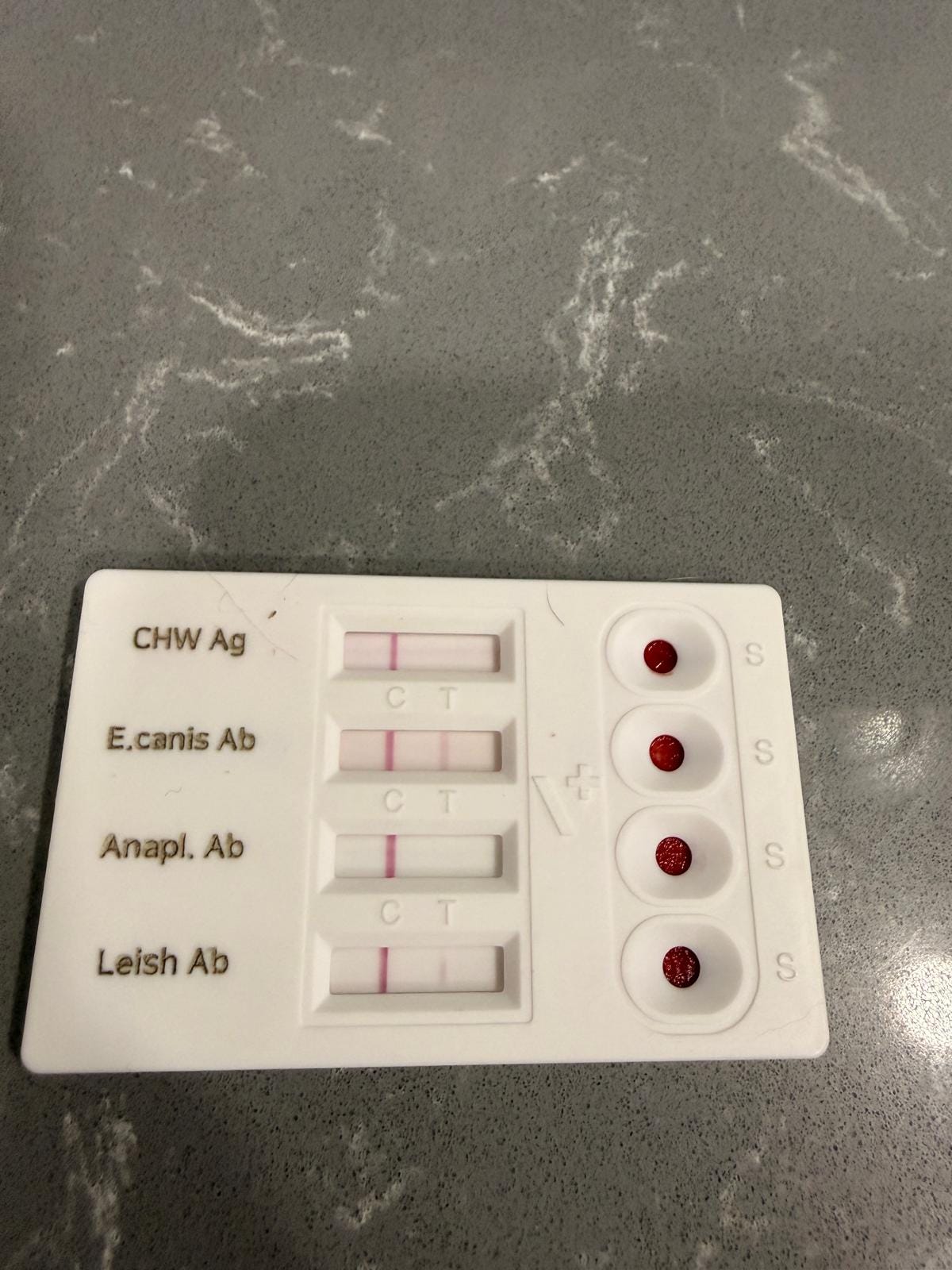
Leishmaniasis is a very different challenge. Before becoming involved in stray dog healthcare, it was often presented to me as just another disease with a straightforward treatment pathway. Experience has taught me otherwise. Today, it sits alongside distemper and parvovirus as one of the diseases I dread hearing about. Caused by a parasite transmitted through infected sandflies, leishmaniasis can affect multiple organs throughout the body and while treatment can often control the disease, there is no simple cure. Some dogs remain stable for years while others deteriorate despite everyone’s best efforts. The disease can affect the kidneys, skin, eyes, joints and immune system, making it one of the most complex and unpredictable conditions we encounter in rescue medicine.
Perhaps part of the reason I feel so strongly about leishmaniasis is that it was the disease that eventually took our dear Jess. Many supporters will remember the long battle to keep Jess comfortable, stable and enjoying life for as long as possible. While we were grateful for every day we had with her, losing her was a painful reminder that leishmaniasis is not always a disease that can be defeated.
This month, Izzy began treatment for her own battle with leishmaniasis. Unfortunately, we already know that the disease has caused significant damage to her kidneys. The kidneys act as the body’s filtration system, removing waste products from the blood while helping regulate fluids, blood pressure and essential minerals. When leishmaniasis damages the kidneys, that damage is often permanent. Treatment may slow the progression of disease and improve quality of life, but it cannot restore kidney tissue that has already been lost.
The reality is that Izzy is unlikely to have a long life ahead of her. Many organisations would look at a dog in her position and conclude that the resources could be better spent elsewhere. Faced with a poor prognosis, ongoing medical costs and an uncertain future, some would consider her a lost cause.
At Dog Desk Animal Action, we do not operate that way.
We believe that every dog deserves a chance, not because every dog can be cured or because every dog can be saved, but because every dog deserves safety, comfort, freedom from pain and the opportunity to experience happiness for whatever time remains. The value of a life is not determined by how many years are left but by the quality of those years and whether that animal is given the opportunity to live them without fear and suffering.
That is why Izzy now lives in foster care. Instead of facing an uncertain future alone, she has warmth, routine, companionship and people who care about her. She has a soft bed, good food, access to veterinary treatment and, perhaps most importantly of all, security. None of us know whether Izzy has months ahead of her or years, but we do know that every day she wakes up safe matters.
We recognise that not everybody will agree with this approach. Animal welfare is full of difficult decisions and finite resources, and we respect that different organisations make different choices. Our work is funded through restricted pots, meaning supporters choose which projects and animals they wish to help. The people supporting Izzy are doing so because they believe, as we do, that a dog’s worth is not measured by the length of her future but by her right to have one.
Izzy may never be cured and she may never fully escape the consequences of what has happened to her, but she survived injuries that should have killed her, fought her way through emergency surgery, infection and recovery, and continues to greet the world with the same gentle nature that carried her through those darkest days. For as long as Izzy wants to keep fighting, we will continue to stand beside her.
God Bless you for giving this sweet girl a chance. It is wonderful to know that her life is filled with so much love. My prayers are with you all. 🤗🙏🏻❤️
It amazes me that dogs like Izzy can still love and trust people after experiencing such traumatic abuse. How is she doing now? 🖤🐾