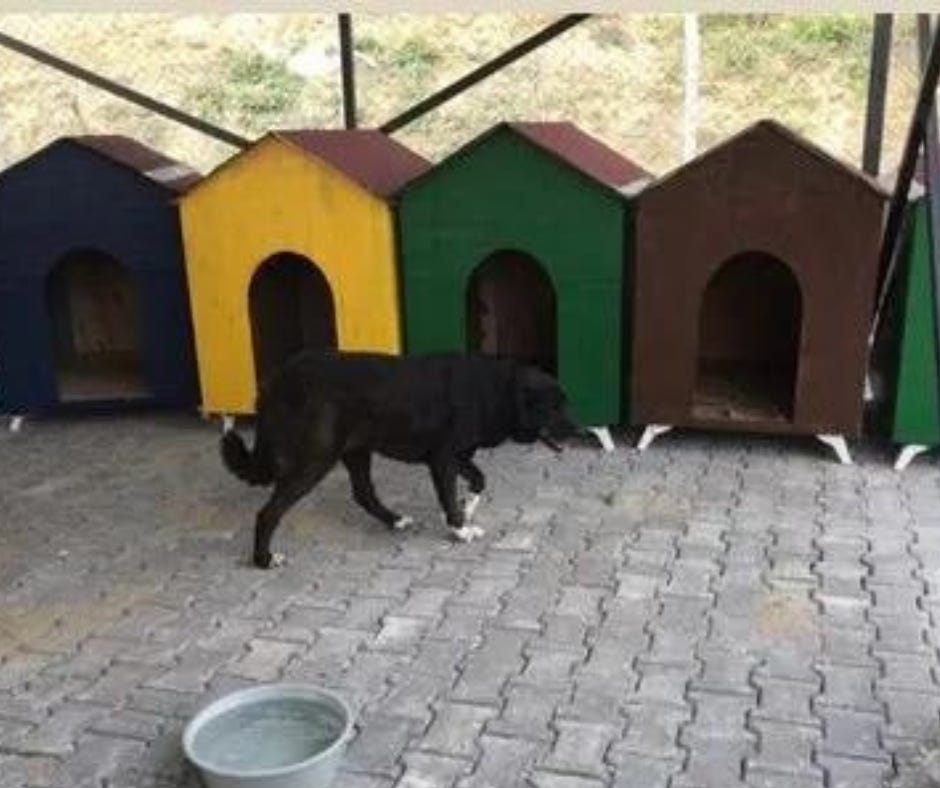
Why We Don’t Use Concrete Kennels
People often expect a shelter to look a certain way.
Rows of pens.
Hard floors.
Hose-down cleaning.
Dogs behind bars waiting to be chosen.
Concrete kennels feel practical. They are easy to disinfect, easy to manage, easy to organise. But what is practical for systems is not always what is healing for animals.
Rescue is not storage. It is recovery.
Confinement Preserves Behaviour It Doesn’t Change It
A dog who has lived in fear learns to stay alert.
When placed into a small enclosed kennel, that alertness has nowhere to go.
So it grows.
You begin to see:
Repetitive pacing
Spinning
Fence fighting
Barrier barking
Shutdown silence
These behaviours are often labelled kennel stress, but they are really unspent survival energy. The dog is ready to react but cannot act. A confined space keeps the nervous system switched on because escape is impossible. And a brain preparing to cope cannot learn to relax.
Space Allows Emotional Regulation
In a larger shared environment, dogs control interactions themselves.
They can:
Walk away from tension
Rest out of sight
Approach slowly
Observe before engaging
These small decisions matter. Each one tells the brain that conflict can be avoided without escalation.
That is how behaviour changes.
Many dogs labelled reactive are not aggressive.
They are trapped communicators.
When movement becomes possible, communication becomes subtle again:
a glance instead of a lunge, a pause instead of a bark, distance instead of confrontation
Recovery Happens During Ordinary Moments
Concrete kennels manage animals efficiently. But recovery does not happen during management routines. It happens when nothing specific is happening.
A dog lying in sunlight. Another choosing to sleep near, but not touching.
A quiet walk across open ground. The freedom to leave the group and rejoin later.
These are not enrichment activities.
They are emotional rehearsal.
The nervous system learns:
I can exist without defending myself.
That lesson cannot be taught through bars.
The Body Heals Differently Too
Hard surfaces affect more than comfort.
Many rescued dogs arrive with:
joint strain
old fractures
muscle loss
neurological tension
Constant standing and circling on rigid flooring keeps muscles braced and sleep shallow.
Soft ground and varied terrain encourage stretching, proper rest, and natural movement patterns.
The body relaxes, and when the body relaxes, behaviour follows.
When We Do Use Kennels
There are times separation is necessary.
Medical recovery.
Careful introductions.
Protection of vulnerable dogs.
Cooling-off periods after conflict.
In those cases, a kennel becomes a tool, not a lifestyle. Temporary structure supporting long-term freedom.
The goal is always return, not residence.
Safety Looks Different Than Order
Rows of quiet kennels look controlled to humans. But stillness behind barriers is often suppression, not calm.
Real calm contains movement.
Dogs wandering without tension.
Sleeping deeply in open areas.
Choosing proximity instead of being assigned it.
This environment can appear less tidy. But it is far more stable.
Because behaviour shaped by choice lasts longer than behaviour shaped by restriction.
What We Are Actually Trying to Create
We are not trying to house dogs. We are trying to give them back the ability to exist without constantly preparing for danger.
Concrete kennels are efficient at keeping animals contained. They are less effective at teaching animals they no longer need to be.
So when you see dogs resting in open spaces, drifting between company and solitude, you are not seeing a lack of structure. You are seeing the structure they were missing before:
predictability
distance
and the freedom to relax
And that is usually the moment recovery truly begins.


