
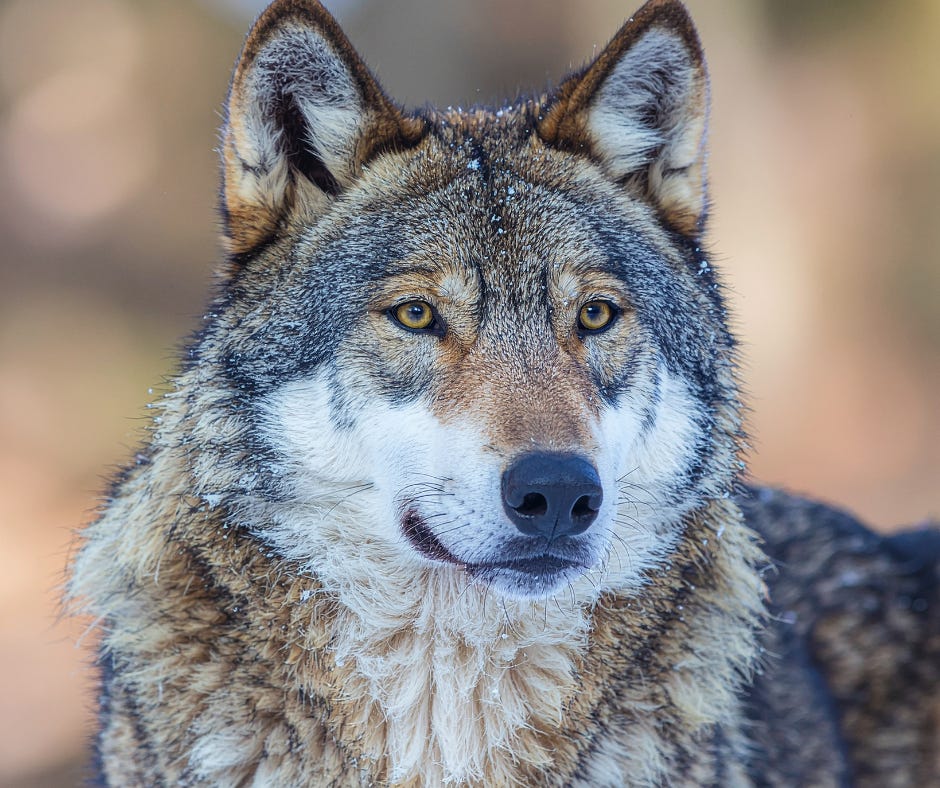
A wolf pack in Kent was euthanised after what was described as a severe escalation in aggressive behaviour inside the group.
Multiple animals suffered life-threatening injuries. Staff could no longer safely intervene. The pack, which had lived together for years, had reached a point where welfare could not be maintained.
Other reports describe it more starkly:
something in the group changed, unity was replaced by conflict, leading to sustained and dangerous infighting.
This has been framed in headlines as wolves turning on each other.But that framing misses the point entirely.
Wolves Do Not Randomly Collapse into Violence
In the wild, wolves are not unstable animals. They are structured, cooperative, and deeply social. A pack is not a random collection of individuals, it is a family:
Parents lead
Offspring remain for years
Conflict is controlled, ritualised, and often avoided
Serious injury inside a natural pack is rare because it is evolutionarily costly. A wounded wolf is a dead wolf.
So when we see sustained, escalating violence like this, the correct question is not:
Why did the wolves turn on each other?
It is:
What conditions removed their ability to function as a pack?
What the Reporting Quietly Tells Us
If you read the details carefully, the explanation is already there.
The wolves were in a contained environment
Staff could not safely intervene once conflict escalated
Relocation or separation was considered not viable
Welfare depended on maintaining a stable pack structure
This is critical. Because it highlights the central issue:
The system could not absorb conflict once it began.
What Breaks a Pack (Real or Simulated)
Whether in a simulation, a zoo enclosure, or a poorly managed dog group, the same failure points appear.
1. No Exit
In the wild, tension has an outlet.
Subordinates leave. Dispersal is a natural behaviour in wolf packs.
Individuals create distance
Conflict disperses across territory
In confinement, there is nowhere to go.
Pressure builds → conflict has no release → escalation becomes inevitable.
2. Artificial Grouping Over Time
Even when a group starts as a family, time changes dynamics:
Offspring mature
Competition increases
Hierarchies shift
In nature, this leads to dispersal. In confinement, it leads to challenge without escape.
3. Space Without Function
An enclosure can look large. But it is not territory.
No true hunting
No meaningful dispersal
No shifting boundaries
Without these, space becomes static and static space compresses social tension.
4. Stress Without Resolution
Captive environments often create:
Repeated encounters
Predictable feeding
Constant proximity
There is stimulation, but no resolution. Over time, this erodes tolerance.
5. The Point of No Return
Once serious injury occurs inside a pack:
Fear replaces familiarity
Individuals pre-emptively defend themselves
Conflict becomes self-reinforcing
At that stage, what you are seeing is not a fight. It is a system collapse.
This Is Not Just About Wolves
This matters beyond this case. Because the same misunderstanding appears again and again:
In kennel-free dog environments without space & the means for a dog to remove itself from the pack
In poorly structured rescue group housing
In the idea that they will sort it out themselves
They will but only if the system allows it.
Remove:
choice
space
exit
structure
and you don’t get harmony. You get escalation.
The Uncomfortable Truth
The most important line in all of this is simple:
Wolves are highly social animals whose welfare depends on stable pack dynamics.
That is true. But stability is not something you can freeze in place. It depends on:
movement
change
dispersal
flexibility
When those are removed, the structure does not hold. It breaks.
Final Reflection
What happened in Kent is being presented as a tragic anomaly. It isn’t.
It is a predictable outcome when:
A complex social system is placed inside an environment that cannot support its natural pressure release.
The wolves did not turn on each other. They lost the conditions that allowed them not to.


