


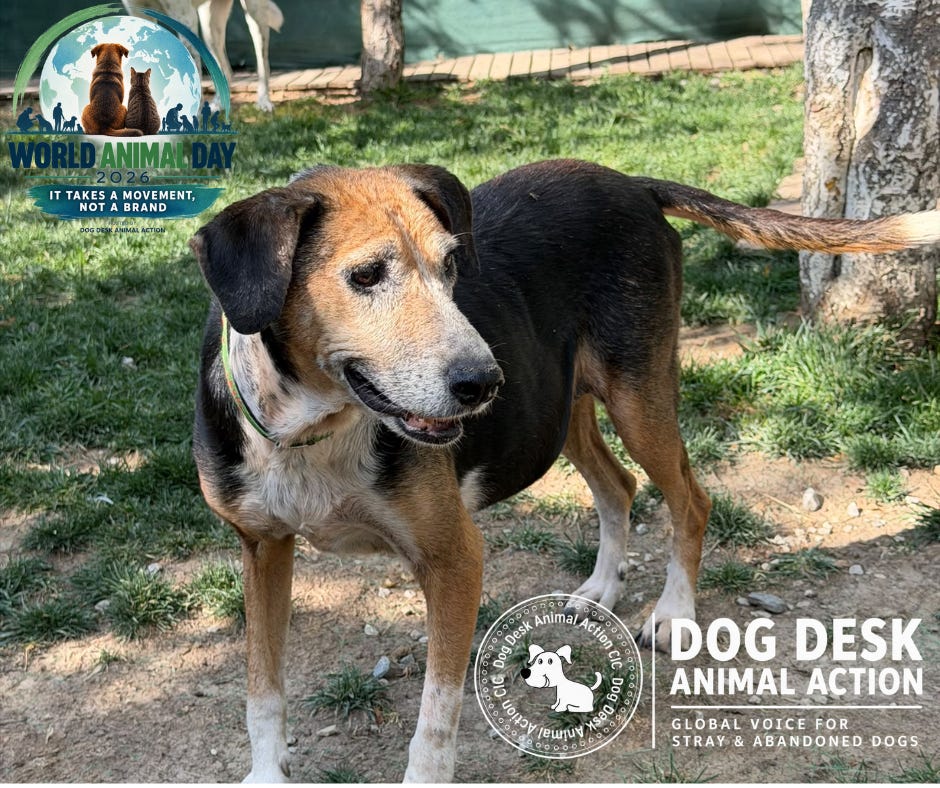
Open social media and you could be forgiven for thinking that animal welfare belongs to a handful of enormous organisations. The same names dominate our feeds, their rescue videos are watched millions of times, their advertising follows us around the internet and their fundraising operations generate sums most small organisations could barely comprehend. Some make extraordinary promises about saving all the dogs, ending animal suffering or changing the world for animals. I understand the ambition because I share it, but there is a difference between an ambition and a claim, and on World Animal Day I think we need to talk about that.
No organisation is going to save all the dogs. Not ours, not theirs, not anybody’s. There are hundreds of millions of free-roaming dogs around the world and we don’t even know precisely how many because countries define and count them differently, where they count them at all. Some are genuinely unowned, some are community dogs, some are owned dogs allowed to roam, some have been abandoned and others were born on the street. More importantly, they aren’t experiencing one enormous global problem waiting for one enormous global organisation to solve it.
What we call the global stray dog problem is actually thousands of different problems created by different combinations of abandonment, uncontrolled breeding, inaccessible veterinary care, poverty, rabies, poor legislation, weak enforcement, irresponsible ownership and political decisions. The circumstances facing a street dog in Türkiye are not the circumstances facing a community dog in India, and the solutions required in Pakistan will not automatically be the solutions required in Romania, Sri Lanka or the UK. There is no single intervention that can simply be scaled up until every dog in the world is safe.
That might sound obvious, but I am not convinced it is obvious anymore. When the same handful of huge brands dominate online animal welfare spaces and repeatedly present themselves as the people who are going to solve the problem, eventually people start to believe them. And that is where an ambitious marketing message can have consequences far beyond fundraising.
What happens when ordinary citizens genuinely believe somebody else is going to save all the dogs? Why get involved? Why support the woman sterilising dogs in her town? Why donate to the tiny organisation struggling with veterinary bills? Why foster, volunteer or learn about what is happening locally? Why challenge your municipality or ask your government what it is doing? Why take responsibility for the animals living in your own community if one of the world’s biggest animal organisations has already told you that it is taking care of them?
Except it isn’t. It can’t. No international organisation, however wealthy, can replace millions of citizens taking responsibility for what happens around them, and no marketing campaign should leave us believing that it can.
There is another consequence of concentrating so much attention around a small number of enormous brands. Everybody else starts to disappear. The smaller organisations become invisible, independent rescuers become invisible, community carers become invisible, local vets become invisible and the people who know every dog on a particular street become invisible. They may still be doing exactly the same work every day, but increasingly they are doing it outside the public’s field of vision.
That invisibility has consequences because attention is not just attention anymore. Visibility brings donations, volunteers, foster homes, adopters, media coverage and influence. An organisation seen by millions has opportunities that somebody working quietly within one community simply does not have. The danger is that we begin directing resources according to who is best at capturing attention rather than according to where resources can actually achieve the most for animals.
There is a brutal cycle at work here. Visibility brings money, money creates capacity, capacity makes it possible to employ people to produce more content, that content creates greater visibility and greater visibility attracts more money. Meanwhile, the person trying to feed 60 dogs before going to work doesn’t have a marketing department. The tiny organisation trying to pay this week’s veterinary bill doesn’t have somebody editing dramatic videos. They are too busy doing the work. Less visibility means fewer donations, fewer donations mean less capacity and less capacity makes it even harder to compete for attention.
Eventually we make one of the most dangerous mistakes possible in modern animal welfare. We confuse visibility with impact.
They are not the same thing. An organisation can have millions of followers while a woman with 300 followers can still be the reason hundreds of dogs in her community are alive, vaccinated and sterilised. The algorithm cannot tell us which one has achieved more for animals. It can only tell us which one was better at holding our attention.
Animal suffering happens to be extraordinarily good at holding attention. The emaciated dog, the puppy in the drain, the terrified animal, the rescue, the transformation and the happy ending are enormously powerful stories. Those animals may genuinely need rescuing and their stories deserve to be told, but rescue is only one part of animal welfare. If our understanding of the entire movement is being formed through the content that performs best online, we are seeing a very distorted version of the work required to create lasting change.
The work capable of preventing the next dog from needing rescue is usually far less exciting. Sterilisation isn’t particularly dramatic. Vaccination doesn’t make spectacular content. Population monitoring is unlikely to go viral. Neither is improving responsible ownership, spending years building relationships within communities, expanding access to veterinary care, gathering evidence, challenging legislation or tracking what happens to animals after policies change. Yet this is precisely where much of the long-term work has to happen.
And much of that work is local. When a small organisation or independent rescuer disappears, we don’t simply lose another logo from social media. We lose knowledge accumulated over years. We lose the person who knows where puppies are appearing, which dogs have already been sterilised, where abandonment regularly happens, which neighbourhood has suddenly started reporting sick dogs and whether the municipality actually delivered what it promised. We lose relationships, trust, history and eyes on the ground. Those things cannot simply be recreated by an international organisation arriving with money.
There is another consequence that worries me even more. When citizens are persuaded that animal welfare is something being dealt with by professional rescuers and enormous charities, governments get an easier ride. Free-roaming dog populations are not simply a charity problem. They are a public-policy problem. Governments make laws, regulate breeding and ownership, control public veterinary services, determine enforcement, manage public-health responses and decide how public money is spent. Charities can rescue, sterilise, vaccinate, educate, investigate, research, campaign and fill gaps, but charities cannot become governments and nor should they.
If citizens believe somebody else is solving the problem, pressure on the institutions actually capable of creating systemic change can disappear. The citizen becomes a spectator. We watch the rescue, share the video, send the donation and scroll to the next one. We have participated in the content, but we have not necessarily participated in changing anything.
That isn’t a movement. It is an audience.
Animals need a movement. They need national organisations capable of challenging laws, researchers producing evidence, veterinarians, responsible owners, community carers, independent rescuers, small organisations operating from kitchen tables, volunteers, foster homes, donors and campaigners. They need the person who sees an injured dog at the side of the road and refuses to drive past. They need all of them because no individual part of this system can possibly do the job alone.
This isn’t an argument against large organisations. Their resources can achieve things smaller organisations simply cannot. Nor is it an argument that small organisations are inherently better. It is an argument against allowing animal welfare to become synonymous with a handful of brands, because a healthy movement should be enormous, decentralised and impossible for any one organisation to own. It should consist of thousands of organisations and millions of citizens working in different places, with different skills and different approaches, while local knowledge is supported by national and international resources.
Perhaps the most damaging thing we could do is convince ordinary people that their participation is no longer necessary because somebody bigger, richer and more famous has promised to take care of everything. The reality is precisely the opposite. The scale of animal suffering means we need more people involved, not fewer. We need more local capacity, more informed citizens, more veterinary access, more accountability and more people willing to look at what is happening around them and decide that they have a part to play in changing it.
Perhaps that message isn’t as marketable as promising to save all the dogs. There is no single hero in it and nobody gets to stand at the centre claiming the movement as their own. Good. Because if we genuinely want a world where fewer animals suffer, our ambition should not be to build one organisation powerful enough to save every dog. It should be to build millions of people, communities and institutions capable of protecting the animals around them.
One creates followers. The other creates change.
This World Animal Day, I am not interested in celebrating the biggest logo, the biggest following or the biggest promise. I want to celebrate the movement, including the people whose names we will never know and whose work will never appear in our feeds.
Because nobody is coming to save all the dogs.
It takes a movement, not a brand.