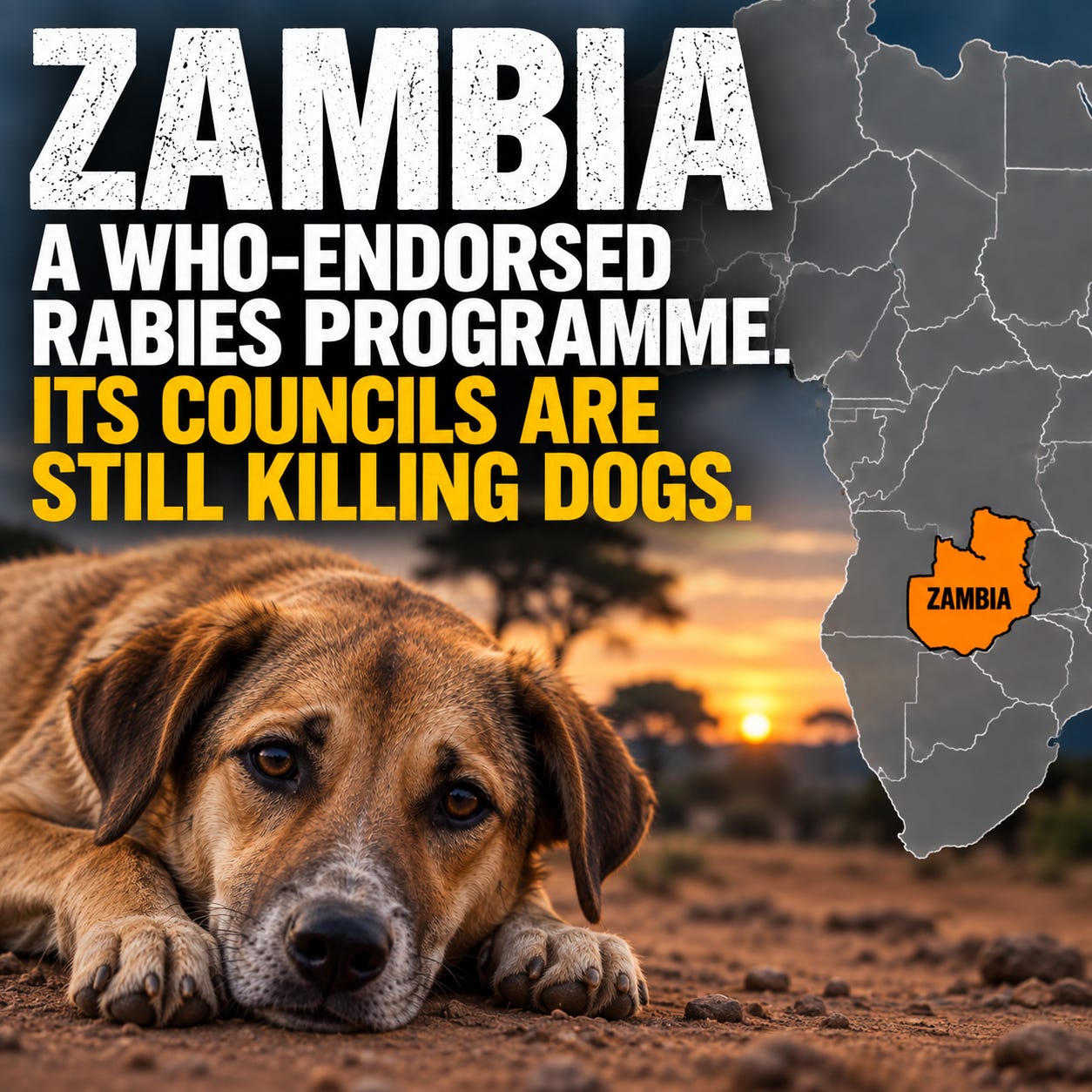
Zambia has been classified as Stable on the Dog Desk Animal Action Global Stray Dog Crisis Map. We are changing that.
The trigger is not one isolated incident or an allegation from an animal welfare organisation. It is evidence of official dog-killing operations carried out as part of rabies and stray dog control, supported by legislation that permits dogs to be destroyed.
On 8 September 2026, Solwezi Municipal Council confirmed that 56 stray and unvaccinated dogs had been killed during a month-long operation following a human death from rabies. The language used by the authorities is striking. This was described as a dog elimination exercise, with the council’s Director of Public Health saying that the authority was working to prevent rabies through the elimination of stray and unvaccinated dogs.
That might have been treated as an emergency response by one municipality. It isn’t.
Other Zambian councils have used the same approach. Kasama Municipal Council has conducted its own month-long stray dog elimination exercise, intended to reduce the stray-dog population, dog bites and the risk of rabies. Solwezi itself has previously announced elimination exercises under Zambia’s Control of Dogs Act.
Then there is Chinsali. In February 2026, Zambia’s national government told Parliament about its response to a rabies outbreak there. Vaccines were dispatched and targeted dog vaccination was undertaken, but government also confirmed that dogs without registration or valid vaccination certificates had been humanely put down.
This takes the issue beyond individual councils. Lethal control is being used within Zambia’s response to free-roaming dogs and rabies at both municipal and government level.
And that becomes particularly difficult to reconcile with what Zambia is supposed to be trying to achieve.
Zambia has a national programme for the elimination of dog-mediated rabies which has been endorsed by the World Organisation for Animal Health, WOAH. The programme is built around mass dog vaccination, surveillance and a One Health approach, with vaccination coverage of around 70% required to interrupt transmission.
Zambia has received substantial international support for that work. In December 2025, WOAH supplied the country with 100,000 doses of rabies vaccine.
In Solwezi, the estimated dog population is around 5,000. Reporting on the current operation says just 285 dogs were vaccinated during the second quarter of 2026. Officials acknowledged that annual vaccination coverage can sit at around 30–40%, increasing considerably when free vaccines are available from government or partners.
That creates an uncomfortable question. If adequate vaccination is not reaching the dogs, should being unvaccinated then become a reason for killing them?
There is evidence that this contradiction has been recognised before. During an expert assessment of Zambia’s rabies programme, WOAH recorded that Zambia had identified lack of funding to procure ammunition to destroy stray dogs and cats as one of the challenges affecting rabies control.
A country pursuing the elimination of dog-mediated rabies through a programme centred on vaccination was identifying lack of money for ammunition to destroy stray animals as a problem.
WOAH challenged the approach. Its assessment pointed out that this method was ineffective for dog population management and sought clarification about how Zambia intended to manage and monitor unowned dogs.
The legal framework helps explain why elimination remains available to authorities.
Zambia’s Control of Dogs Act is nearly a century old. Its provisions allow regulations to be made for the destruction of dogs in connection with rabies control, while subsidiary provisions allow certain unregistered dogs found without the required identification to be destroyed.
So when a council announces a “dog elimination exercise”, we are not necessarily looking at officials acting outside the system.
We may be looking at the system itself.
That is why Zambia’s position on the Dog Desk Animal Action Global Stray Dog Crisis Map is changing from Stable to Watchlist.
We are not currently classifying Zambia as Crisis. The country has a substantial vaccination programme and an internationally endorsed strategy for eliminating dog-mediated rabies. There is no evidence before us of a nationwide campaign to kill Zambia’s free-roaming dog population.
But Stable no longer adequately describes what we are finding.
We now have repeated official dog-elimination operations, evidence from more than one municipality, acknowledgement of lethal control by national government and legislation capable of supporting the destruction of dogs.
We also have questions which need answers.
How many Zambian councils currently conduct dog-elimination exercises? How many dogs are killed every year? What methods are used? What happens when an owned but free-roaming dog is encountered? How much warning is given to communities? What proportion of dogs killed are suspected of rabies, and how many are killed simply because they are stray, unregistered or unvaccinated?
Most importantly, we want to understand why lethal population control continues to operate alongside a national strategy built around mass vaccination.
Rabies is lethal. Protecting people from it is not optional. Neither is effective dog vaccination.
But when vaccination coverage falls short and being unvaccinated can then contribute to a dog’s death, scrutiny has to fall on the system responsible for providing that vaccination as well as on the dog.
Zambia is no longer Stable, it is now on our Watchlist.


