

From 28 September 2026, dogs found roaming at night in Mutare may be shot by authorised personnel.
That is the starkest part of a new citywide confinement order issued after a dog collected in Dangamvura tested positive for rabies. During the day, roaming dogs are to be captured and taken to the Society for the Prevention of Cruelty to Animals (SPCA). At night, the response may be a bullet.
The council has given owners until 27 September to secure their properties, confine their dogs, vaccinate them against rabies and obtain municipal licences. Dogs captured during the day may be reclaimed, but the notice reportedly says that any remaining unclaimed after 14 days will be disposed of. It does not explain what that means.
Mutare’s order is serious in its own right. When it is placed alongside recent and historical evidence from other Zimbabwean cities, however, it reveals something larger: the shooting of roaming dogs is not an exceptional response confined to one municipality.
What Mutare has ordered
Mutare City Council says the confinement order is being enforced under section 13 of the Mutare (Dog Licensing and Control) By-laws, Statutory Instrument 55 of 1986. It follows an increase in reported dog bites and the discovery of a rabies-positive dog collected in Hillsview/Linkview, Dangamvura, on 18 August.
The compliance period runs from 14 to 27 September. Enforcement is due to begin the following day.
According to reports reproducing the council’s requirements:
dogs found roaming during the day will be captured and surrendered to the SPCA;
owners wishing to recover them must meet the SPCA’s requirements;
dogs roaming at night may be shot by duly authorised and trained personnel; and
dogs not claimed within 14 days will be disposed of in accordance with legal and animal-welfare requirements.
The order says the council will work with the Department of Veterinary Services, municipal police and the SPCA. The SPCA is an animal-welfare organisation, not a municipal department. Nothing published so far establishes whether the local branch agreed to receive every collected dog, how much space it has, who will fund the additional care or what will happen if its capacity is exhausted.
There are other critical gaps. The signed notice has not been located publicly. Neither has the full text of the cited Mutare by-law. No published protocol explains who may shoot dogs, how they will distinguish an owned or vaccinated animal in darkness, how wounded dogs will be located and treated, or what records will be kept for each animal killed or collected.
There is also no evidence that a dog has yet been shot under this particular order. Enforcement does not begin until 28 September but it does not reduce the seriousness of a policy that expressly permits shooting.
This is not an isolated municipal response
In April 2026, Kwekwe City Council began an operation covering multiple suburbs and mining areas. The published schedule ran from 20 April to 27 May. The mayor confirmed that the city had started shooting stray and roaming dogs following reported rabies cases and said that a similar exercise had taken place the previous year.
His description suggested an established municipal practice: the council issues a notice, allows time for compliance and then carries out scheduled shooting.
Bulawayo provides even clearer evidence. In an official notice dated 11 April 2025, the city announced a month-long tie-up order to be enforced with the Zimbabwe Republic Police, veterinary officials and the SPCA. Its wording was unequivocal: all stray dogs found during the enforcement period would be shot.
This was not merely a threat on paper. Council records reported by Zimbabwean media show that Bulawayo shot 271 dogs during an operation in February and March 2015. The exercise was temporarily interrupted when ammunition ran short. Forty-five dogs were killed in Cowdray Park alone.
The evidence therefore includes a current order authorising shooting in Mutare, a 2026 operation in Kwekwe described by its mayor as an established response, an official 2025 shooting notice in Bulawayo, and a documented Bulawayo operation in which hundreds of dogs were killed.
A national strategy moving in the opposite direction
Zimbabwe does not appear to have issued one national directive ordering every council to shoot roaming dogs. Municipal authorities are acting through local dog-control measures, often described as tie-up orders.
At national level, the stated direction is markedly different.
Zimbabwe developed a National Strategic Plan for dog-mediated rabies control with support from the World Organisation for Animal Health (WOAH). The plan centres on mass dog vaccination, dog-population management, surveillance, access to human post-exposure treatment and public awareness. In May 2026, WOAH endorsed Zimbabwe’s official rabies-control programme after assessing it against international standards.
That endorsement recognises the existence of a credible national framework. It does not certify every local enforcement practice, and it does not make municipal shooting operations consistent with effective rabies control.
WOAH’s international guidance states that euthanasia used alone is not an effective means of dog-population management. The global Zero by 30 strategy focuses on preventing human deaths by stopping transmission at its source through sustained vaccination, surveillance, education and access to treatment after exposure.
The contrast is difficult to ignore. Zimbabwe is seeking international recognition for a vaccination-led elimination strategy while some of its councils continue to authorise or carry out the shooting of dogs found outside their owners’ properties.
Rabies is fatal once symptoms appear, and authorities have a duty to protect people. But shooting roaming dogs is not a substitute for maintaining high vaccination coverage, investigating exposures, ensuring prompt treatment for bite victims, managing waste and breeding, licensing owned animals, and building humane collection and holding systems with adequate capacity.
Nor does roaming prove infection. A dog outside a gate may be unvaccinated, vaccinated, abandoned, lost or simply living in a community without secure fencing. None of those possibilities can be established through a rifle sight at night.
Why Zimbabwe now meets the Crisis threshold
Dog Desk Animal Action classifies a country as Crisis where credible evidence shows serious or widespread threats to the welfare, safety or survival of stray and free-roaming dogs. A country does not have to meet every indicator. Classification depends on the overall weight, seriousness and scale of the evidence.
Zimbabwe now meets that threshold.
The evidence includes government-sanctioned or officially permitted killing, documented municipal shooting operations, a sustained pattern involving several cities, and policies creating a substantial risk to both genuinely ownerless dogs and owned dogs found roaming. Mutare’s daytime collection order adds unanswered questions about holding capacity, traceability and the outcome of dogs left unclaimed for 14 days.
This is not a national classification based on one incident. It reflects multiple authorities, more than one year of recent enforcement, documented historical killing and a present risk that further dogs will be shot when Mutare’s enforcement period begins.
Zimbabwe has therefore been classified as Crisis on the Global Stray Dog Crisis Map.
Questions that require urgent answers
Before enforcement begins, Mutare City Council and the relevant national authorities should publish the original signed order and answer the following questions:
What exact legal provision authorises the shooting of roaming dogs that are not confirmed or suspected to have rabies?
Who is authorised to shoot them, and what training, supervision and animal-welfare protocol will apply?
How will personnel distinguish a stray dog from an owned, lost or vaccinated dog, particularly at night?
What procedure will ensure that any wounded dog is found immediately and does not suffer?
What does “disposed of” mean for a dog left unclaimed after 14 days?
How many dogs can the local SPCA safely accept, and has it agreed to the role assigned to it?
What individual intake, reclaim, transfer, death and killing records will be kept and made public?
How does the operation align with Zimbabwe’s WOAH-endorsed national rabies-control programme?
Kwekwe should also publish the number of dogs collected and shot during its 2026 operation, while Bulawayo should disclose the outcome of its 2025 tie-up order. Without transparent records, the scale of killing cannot be fully measured and the fate of removed dogs cannot be traced.
Public safety and animal welfare are not opposing goals
Communities must be protected from rabies and serious dog attacks. Dogs must also be protected from indiscriminate or poorly controlled killing. Effective policy does both.
Zimbabwe already has the foundation of a better approach in its national rabies strategy. What is missing is clear evidence that municipal practice is aligned with it: vaccination at sufficient scale, humane and traceable collection, adequate holding space, veterinary assessment, public reporting and tightly defined emergency powers.
Mutare’s order does not provide that assurance. Instead, it creates two classes of roaming dog according to the time of day: one may be captured; the other may be shot.
That is not a coherent humane-management system, and it demands scrutiny before the first night of enforcement begins.
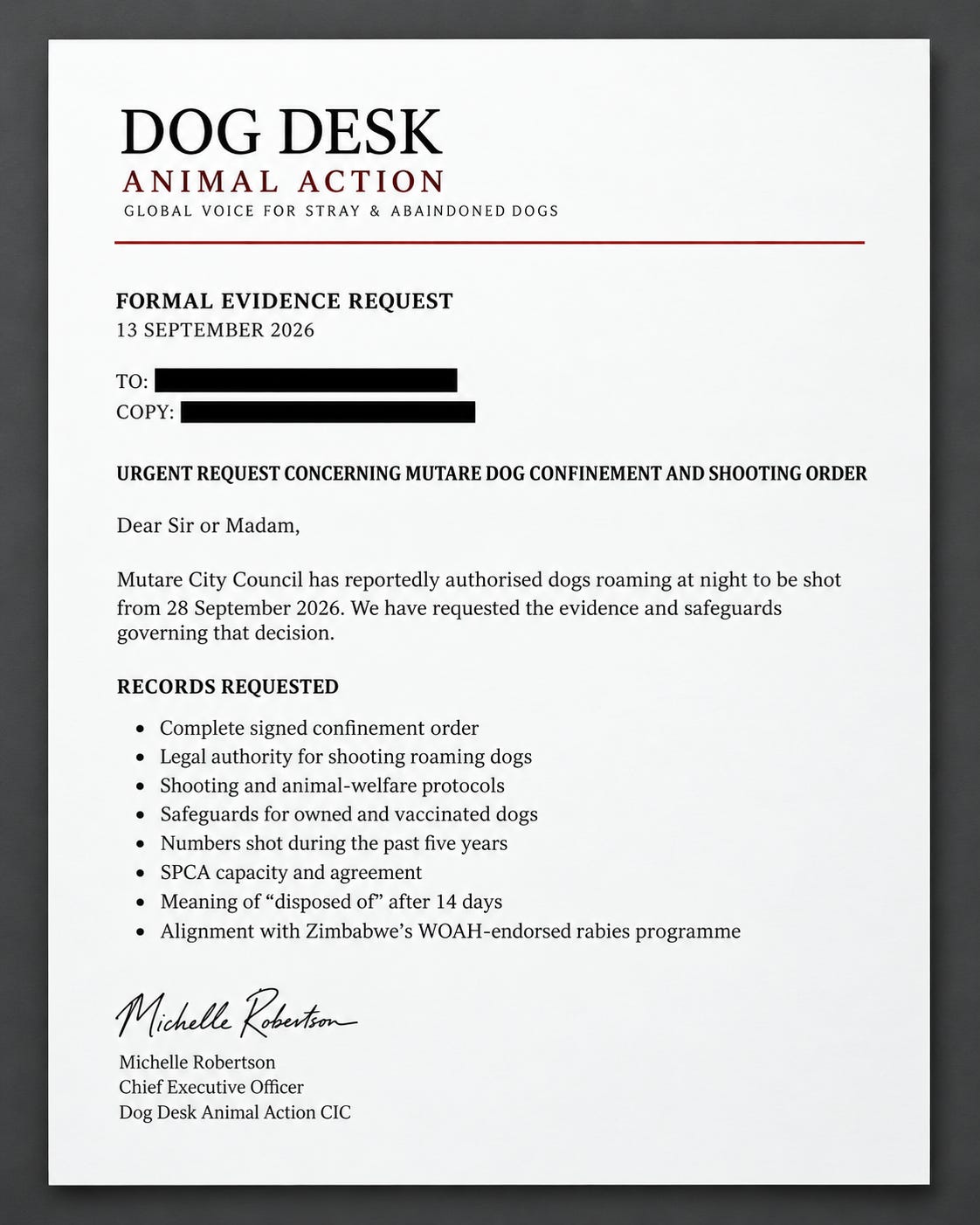
Dog Desk Animal Action has sent Mutare City Council a formal 20-point request seeking the signed order, the legal authority for shooting roaming dogs, the operational safeguards, records of dogs killed and clarification of what happens to dogs left unclaimed for 14 days.
Graphic summary of our correspondence not a reproduction of the original email. Recipient details have been redacted.